In a quiet farming village in East Java, beneath a mound of earth that locals had eyed suspiciously for forty years, archaeologists uncovered something that no historian had expected to find: a single, perfect day, preserved in stone for almost eleven centuries.

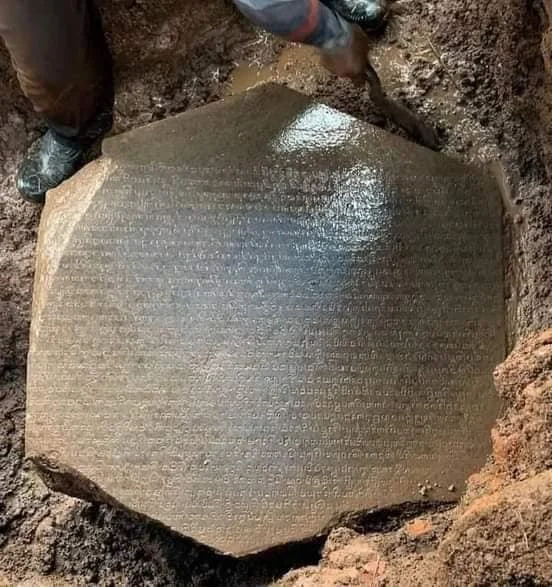
It was February 2022. A team was carefully clearing the corner of a long-buried temple when their tools struck a slab of dark andesite, cracked into pieces but still dense with row upon row of elegant, looping script. As epigraphers began to read, the stone gave up its secret — and it was not a record of war, or the death of a king, or some grand cosmic prophecy.
It was, of all things, a story about a rice field, a tax break, a party — and a chilling warning to anyone who dared undo it.
This is the Mpu Sindok inscription, and it may be one of the most intimate windows into everyday life in the ancient world ever pulled from Indonesian soil.
A Stone That Recorded a Single Afternoon
The slab is known today as the Masahar inscription — or the Gemekan inscription, after the village where it surfaced. Carved from andesite and broken into six fragments, the largest piece alone measures roughly 90 centimeters tall and 88 centimeters wide, and still carries more than thirty legible lines of Old Javanese writing on all four of its sides.
It was found on February 9, 2022, by an excavation team from the East Java Cultural Heritage Preservation Center, tucked into the northeast corner of a ruined temple structure near Sooko, in Mojokerto Regency. The temple itself had been a local legend for decades; villagers had noticed strange stone outcrops poking from the earth since the 1980s. But it took until 2022 for archaeologists to fully open the ground — and to discover that the broken stone wedged into the shrine was a royal charter nearly 1,100 years old.
When epigraphers from Indonesia’s national research agency studied the script, they pinned the date precisely: it was issued in the year 852 of the Saka calendar — 930 CE — by a ruler whose full title rolls like thunder: Sri Maharaja Rakai Hino Pu Sindok Sri Isanawikrama Dharmottunggadewa.
History knows him simply as Mpu Sindok.
The Decree: A Field, Freed From Tax Forever
At its heart, the inscription records a single royal act — the kind of administrative decision that, anywhere else, would have vanished the moment the ink dried. But in tenth-century Java, when a king made land sacred, he made it permanent, and he made it in stone.
Mpu Sindok declared a plot of rice field in the settlement of Masahar to be a sima: tax-free land. Crucially, this was tarukan land — newly opened ground, freshly cleared and cultivated for the first time. By granting it sima status, the king released its harvest from royal taxation forever, redirecting its yield to support a sacred building, a place of worship in the new community.
The stone even preserves the paperwork. A parcel of land was purchased with a precise sum of gold by local notables — a man and his daughter — and consecrated for religious upkeep. It is a thousand-year-old property deed, a tax exemption, and a temple endowment, all chiselled into rock so that no future official could ever pretend it didn’t happen.
And then, because no great occasion in ancient Java passed without a feast, the stone records the party.
The Oldest Menu You’ll Ever Read
Here is where the Mpu Sindok inscription stops being an administrative document and becomes something almost magical: a snapshot of people celebrating.
The right-hand face of the stone describes the ceremony that sealed the sima — and it ends, as the best ceremonies do, with eating and drinking. The inscription names what was poured and what was served, and reading it now feels like peering over the shoulder of a guest at a banquet held in the year 930.
There was alcohol, and not just one kind. The text lists tuak, a palm wine drawn from the coconut tree; sindhu, likely brewed from rice; and cinca, probably fermented from other plants — a whole drinks menu of ancient Javanese liquor. To accompany the drinking, the feast laid out food that would look startlingly familiar on an Indonesian table today: eggs, dendeng (a dried, spiced jerky of preserved meat), and fish, both salted sea fish and freshwater catch — alongside the boiled vegetables and coconut preparations that rounded out a village celebration.
Pause on that for a moment. This is not a list of treasures or tributes to the gods. It is comfort food. It is the menu of a community throwing a feast to mark a good day — palm wine and jerky and salted fish, shared in the shade of a brand-new shrine, nearly eleven hundred years ago. Local headlines, delighted, summed it up bluntly: the officials of Mpu Sindok’s era had thrown a liquor party to celebrate the tax exemption.
It is one of the rare moments in archaeology where the ancient world doesn’t feel ancient at all. It feels like a Saturday.

The Curse on the Other Side
But the stone has a darker face — literally.
While the right side of the inscription describes the joy of the feast, the left side carries a curse. This was standard, and deadly serious, in Old Javanese charters: to protect a sacred grant from future tampering, scribes inscribed terrifying maledictions against anyone who might dare to violate the sima, seize its land, or strip away its tax-free status.
These curses were not gentle. In inscriptions of this kind, transgressors are condemned to gruesome, often supernatural fates — their bodies torn apart, their lives destroyed, their souls denied peace. The threat was the ancient equivalent of an unbreakable contract, enforced not by courts but by the gods themselves. Carved into stone beside a cheerful menu of eggs and palm wine, the curse is a reminder of just how sacred — and how political — a simple tax decree could be.
A feast on one side. Damnation on the other. The full emotional range of power, captured on a single rock.
The King Who Moved a Kingdom
To understand why this stone matters beyond its menu, you have to understand the man who issued it.
Mpu Sindok ruled the Medang kingdom — also called the Mataram kingdom — a Hindu-Buddhist realm that flourished on Java between roughly the 8th and 10th centuries. He came to power around 929 CE, and he is famous for one momentous decision: he moved the center of the kingdom from Central Java to East Java, shifting the heart of Javanese civilization eastward.
Why? Historians still debate it. Some point to the catastrophic eruption of Mount Merapi, which may have buried the old heartland in ash. Others suspect political pressure, even invasion, from the rival maritime empire of Srivijaya. The leading scholar who deciphered the new inscription argues the move was simply smart economics — the fertile valley of the Brantas River offered richer farmland and better trade routes than the old capital ever could.
Whatever the reason, the relocation reshaped Indonesian history, laying the groundwork for the great East Javanese kingdoms that followed. And the Masahar inscription is a fresh piece of hard evidence from exactly that pivotal moment — one of more than twenty surviving inscriptions from Mpu Sindok’s reign, each helping to map a kingdom in the act of reinventing itself. After Sindok’s death, his own daughter would inherit the throne, continuing the dynasty he founded.
Why a Thousand-Year-Old Tax Break Still Matters

It’s easy to be drawn to archaeology’s giants — the pyramids, the lost cities, the golden tombs. But the Mpu Sindok inscription is a reminder that the most haunting discoveries are sometimes the smallest and most human.
Kings and battles fill the history books because they were carved to be remembered. What almost never survives is the texture of ordinary life: what people ate, what they drank, how they marked a happy day, what they feared enough to write a curse about. This single broken slab preserves all of it at once — economy and faith, celebration and dread, governance and gluttony — frozen at a specific hour on a specific day in the year 930.
And perhaps the most quietly astonishing thing of all is the continuity. The dendeng, the salted fish, the eggs, the coconut, the palm wine described on that stone are not relics of a vanished culture. They are, recognizably, still being eaten and drunk across Indonesia today. The feast that celebrated Mpu Sindok’s tax-free rice field never really ended. It simply moved from one generation’s table to the next, for more than a thousand years.
The villagers of Gemekan walked over that buried party for forty years before anyone knew it was there. Now that the stone has finally spoken, it tells us something no monument ever could: that the people of the ancient world were not so different from us. They cleared their fields, argued over taxes, blessed their temples — and then they sat down together, poured the wine, and ate.
Frequently Asked Questions
What is the Mpu Sindok (Masahar) inscription? It is a 10th-century Old Javanese inscription carved on andesite stone, discovered in February 2022 at the Gemekan site in Mojokerto Regency, East Java, Indonesia. Issued by King Mpu Sindok in 930 CE, it records the granting of tax-free (sima) status to a newly opened rice field, the feast that celebrated it, and a curse against anyone who violated the decree.
How old is the inscription? It is dated to 852 Saka, equivalent to 930 CE — making it nearly 1,100 years old. It was unearthed during a 2022 excavation of a buried temple structure.
What food and drink does the inscription describe? The ceremony ended with a feast that included alcoholic drinks — tuak (palm wine from coconut), sindhu (likely rice-based), and cinca — along with eggs, dendeng (a dried, spiced jerky), salted and freshwater fish, and other dishes such as boiled vegetables. Many of these foods are still eaten in Indonesia today.
Who was Mpu Sindok? Mpu Sindok (full title Sri Maharaja Rakai Hino Pu Sindok Sri Isanawikrama Dharmottunggadewa) was a king of the Medang, or Mataram, kingdom who reigned from around 929 CE. He is best known for moving the kingdom’s capital from Central Java to East Java and founding a new royal dynasty.
What does “tarukan” and “sima” mean? “Tarukan” refers to newly opened or freshly cleared land. “Sima” was a royal grant making land tax-free, usually so its agricultural yield could support a temple or sacred building. Such grants were considered permanent and were protected by inscribed curses.
Why is the inscription historically important? It provides fresh, datable evidence of Mpu Sindok’s reign and the eastward shift of Javanese civilization, while offering a rare, intimate glimpse into the economy, religion, and daily diet of 10th-century Java.
Sources & further reading: The Jakarta Post, The Archaeologist, National Geographic Indonesia, Detik, Kompas, and Wikipedia. Inscription dated and analyzed by epigrapher Titi Surti Nastiti (Indonesia’s national research agency, BRIN).