Stand before the Passion Façade of the Sagrada Família and the first thing you feel is cold. Where Antoni Gaudí’s other surfaces erupt with life, this western face is all hard edges and hollow shadow — gaunt figures, skeletal columns, stone scraped down to bone. It was meant to unsettle you. It was meant to look like death.
But hidden in that severity, the evidence suggests, are two small acts of devotion — both pointing back to one man. And the strangest part? They were carved by a sculptor who had publicly promised he would never try to be Gaudí.
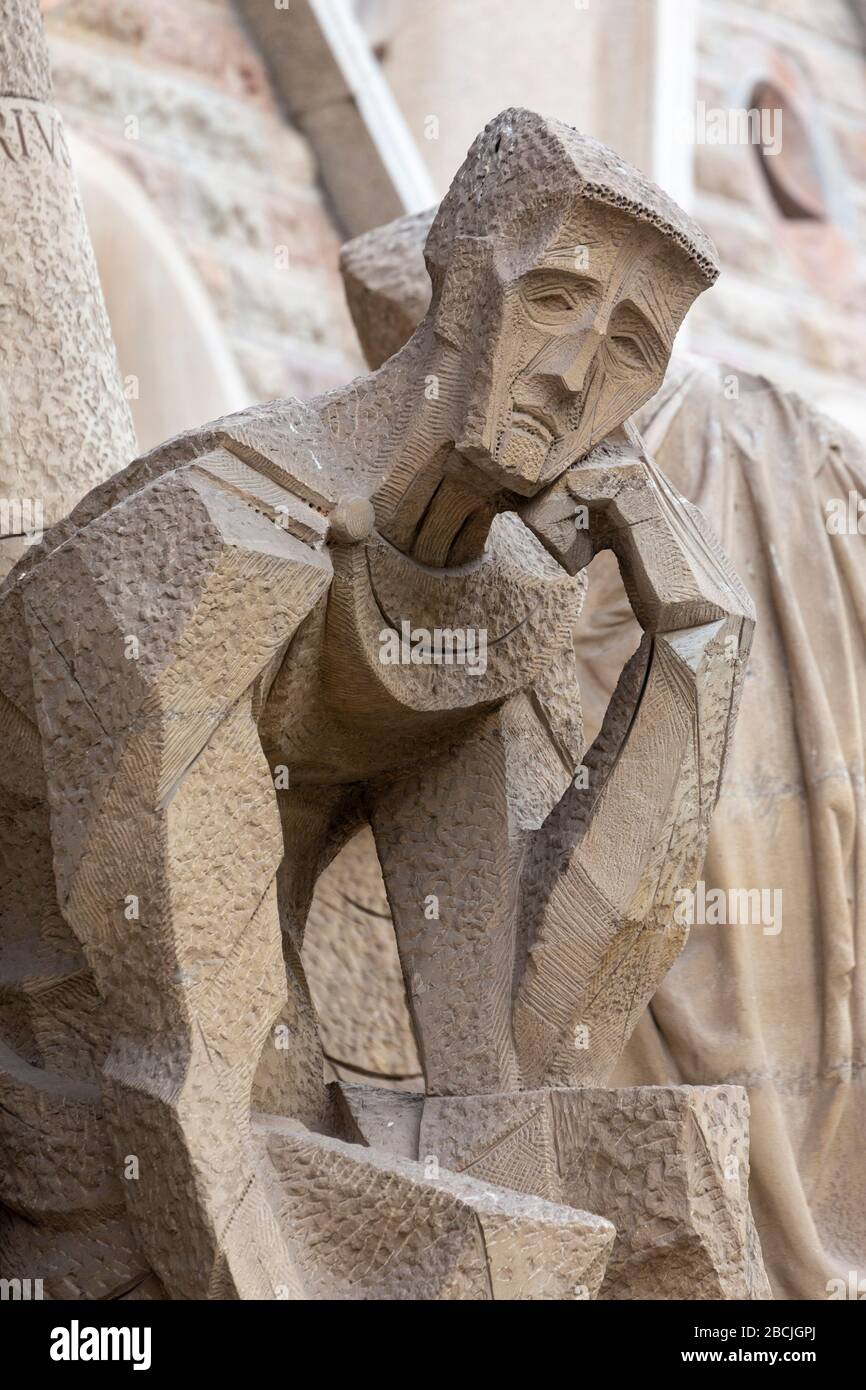
A façade carved by a man who refused to imitate Gaudí
When Gaudí died in 1926, struck by a tram, the Sagrada Família was nowhere near finished — and much of what he left behind was drawings, models and ideas rather than completed stone. Decades later, the basilica needed someone to carve the Passion Façade, the face devoted to the suffering and death of Christ.
That task fell, in 1986, to the Catalan sculptor Josep Maria Subirachs. According to the basilica’s own account, he accepted on one firm condition: total artistic freedom. Out of respect for Gaudí, Subirachs reportedly said, he would not attempt to imitate him. He spent roughly a year studying Gaudí’s drawings, then went his own way — angular, austere, almost Brutalist, a deliberate shock against the organic curves Gaudí is loved for. He cut the figures from pale travertine and sandstone and arranged the scenes to be read like a serpent, climbing the wall from the lower left up toward Christ at the summit, beneath four bell towers dedicated to the apostles James the Less, Bartholomew, Thomas and Philip.
And yet, somewhere in that act of independence, he seems to have changed his mind about one thing. He would not copy Gaudí’s style. But he would smuggle the man himself into the stone.
The kneeling old man who is really Gaudí
Walk along the façade to the scene of Veronica — the woman said to have wiped the face of Jesus, leaving his image on her veil. Just to the side, the story pauses. An old man kneels, gazing up at that image, set slightly apart from the drama as if he too has come only to look.
That man, art historians and the basilica itself say, is Antoni Gaudí. His face here is widely understood as a portrait — some accounts trace it to how Gaudí appeared in a Corpus Christi procession through Barcelona. Subirachs placed the architect among the witnesses to the Passion, a quiet mourner in stone, watching the death he spent his last years preparing this very building to honour. Gaudí, remember, had grown intensely devout by the end — so consumed by the basilica that the city took to calling him “God’s architect,” and when a tram struck him down in 1926 he was at first mistaken for a beggar and nearly left without care.
It’s a tender thing to find on the coldest wall Gaudí’s church would ever wear.

The soldiers whose helmets are a building
Now look for the Roman soldiers — the guards of the Passion, hard-faced men in armour. Something about their helmets is off. They aren’t classical at all. They’re tall, ridged, chimney-like, almost menacing in a way no real Roman helmet ever was.
That’s because, the evidence suggests, they aren’t really helmets. They are chimneys.
Up on the rooftop of Casa Milà — “La Pedrera,” another Gaudí masterpiece across the city — stands a forest of surreal ventilation chimneys, the ones often nicknamed Gaudí’s stone “warriors.” Subirachs is widely said to have modelled the soldiers’ helmets directly on those rooftop figures, some sources calling them an near-exact replica. So the guards menacing Christ on a sacred façade are crowned, secretly, with a piece of Gaudí’s most famous apartment block. Those rooftop chimneys carry their own dark nickname — espanta-bruixes, the “witch-scarers” — hooded shapes sheathed in broken marble and glass that loom over Barcelona like silent sentinels. Lift them onto the heads of Christ’s executioners and the soldiers become something colder and stranger than Rome ever fielded.
The sculptor swore he would never imitate Gaudí — so instead, he hid Gaudí inside the stone.

Two clues, one quiet message
Put the two together and a pattern appears. One detail is the man’s face. The other is the man’s architecture. A portrait, and a building — both lifted out of Barcelona and folded into the Passion of Christ.
Some read it as Subirachs binding two worlds together: the sacred space of the basilica and the everyday, civic genius of Gaudí’s city, stitched into a single “Gaudí universe.” Others simply see the homage of one artist to a giant whose unfinished dream he had been asked to carry. Either way, the message is the same. This is still Gaudí’s church — even the parts he never touched.
Hidden in plain sight
What makes it delicious is that almost no one notices. Millions photograph the Passion Façade every year; most never learn that an old man in the crowd is the architect himself, or that a soldier’s helmet is a chimney from across town.
And these aren’t the only riddles here. The same façade carries a famous “magic square” beside the kiss of Judas — sixteen numbers arranged so that many lines reportedly add up to 33, said to mark the age of Christ at his death. Strictly, mathematicians point out, it isn’t a true magic square at all: a couple of numbers repeat and two are missing — yet its rows, columns and diagonals are said to combine to 33 in scores of different ways, hidden arithmetic pressed into a scene of betrayal. The stone, it turns out, is layered with codes for those willing to slow down and read it.
That’s the trick of the whole wall. It rewards the second look. Glance once and you see grief carved in granite; look again and you find a sculptor leaving fingerprints — and the ghost of Gaudí — tucked into the shadows.
Why it still makes us look twice
We like to think great monuments are finished, sealed, fully explained. The Sagrada Família — still rising, still under cranes a century after its architect’s death — refuses to be. It keeps absorbing the people who build it, hiding their tributes and jokes and grief in plain sight, waiting for someone to notice.
Subirachs kept his word: he never imitated Gaudí. He did something stranger and more loyal instead. He made sure that anyone who really looked would find Gaudí there anyway — kneeling in the crowd, and standing guard in stone.
So here’s the question worth carrying into the next famous building you visit: how many messages are hiding on the walls you walk past without ever looking twice?