Beneath the jungle of Mexico’s Yucatán, the earth opens into deep, water-filled sinkholes called cenotes. To us, they’re stunning natural pools. To the ancient Maya, they were something far more serious: doorways to the underworld.
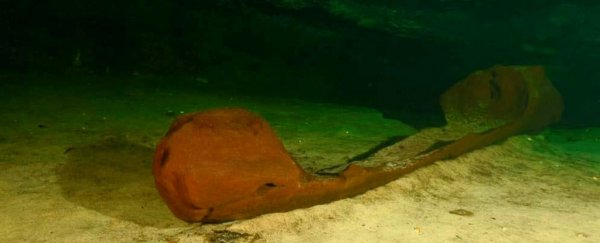
So when divers descended into a cenote near the great ruins of Chichén Itzá and found a wooden canoe resting in the dark water — remarkably intact after centuries — they weren’t just looking at an old boat. They may have been looking at an offering left at the threshold between worlds.
/https://tf-cmsv2-smithsonianmag-media.s3.amazonaws.com/filer_public/09/76/0976ebc3-ba31-4343-846f-5d7daf0f4c57/canoe_3_cropped.jpeg)
What the divers found
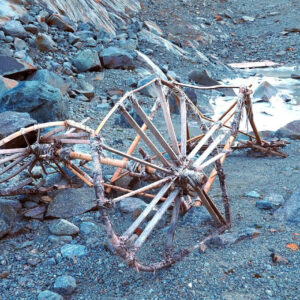
The canoe was discovered in 2021, in the San Andrés area near Chichén Itzá, by underwater archaeologists working ahead of construction in the region. Reportedly the first intact canoe ever found in the Maya world, it had survived submerged and largely undisturbed.
But it was what surrounded it that turned a remarkable find into a haunting one. Nearby, researchers reportedly documented a ceremonial knife, the fragments of around 40 pottery vessels — many seemingly broken on purpose, as offerings often were — and the skeletal remains of several animals: a dog, an eagle, a turkey, and an armadillo. And among them, a human bone: a woman’s foot.
This was not a boat that had simply sunk. This looks, to researchers, like a place where something sacred happened.
A boat too heavy to paddle
Here’s a detail that quietly reframes everything.
By several accounts, the canoe’s construction was relatively heavy — not the light, nimble build you’d want for everyday travel or fishing. That oddity strengthens a striking theory: that it was never really meant to carry people across water at all.
This wasn’t a boat built to cross water. It may have been built to cross worlds.
If so, the canoe wasn’t transport. It was a vessel in the spiritual sense — an object made, or placed, for ceremony at the very mouth of the underworld.
Why a cenote, and why these animals
To understand the scene, you have to step into the Maya worldview.
Cenotes were widely seen as portals — openings to the watery realm of the dead, where the living could send offerings to gods and ancestors. Dropping precious things into that dark water wasn’t loss; it was communication.
And the animals may not be random. The armadillo, in particular, carries eerie significance: able to hold its breath and cross water close to the ground, it was associated in Maya belief with descending into the underworld — and reportedly linked to God L, a deity of that shadow realm. Read that way, the bones aren’t just remains. They may be carefully chosen symbols, each one a message about death, passage, and the world below.

How old is it, really?
Part of the intrigue is that even the date has been a moving target.
Early on, some suspected the canoe might be relatively recent — perhaps even from around the 16th century, near the time of European contact. But further analysis has reportedly pushed it much deeper into the past, toward roughly 830–950 CE — the Terminal Classic, an era when the great Maya centres were undergoing dramatic change.
The investigation continues, and the final answer may yet shift again. For now, the canoe sits at the blurry edge between eras — fitting, perhaps, for an object found at the edge between worlds.
What it tells us about the Maya
Strip it back, and this is what makes the find so moving: it’s a window not into Maya kings or war, but into their beliefs — into how they faced the great mystery of death.
Here was a people who looked at a sinkhole in the jungle and saw a sacred threshold; who built a heavy canoe, gathered meaningful creatures, broke fine pottery, and carried it all into the dark water as a way of speaking to the powers below. We can read the grammar of the ritual even if we’ll never fully translate its meaning.
So here’s the question worth sitting with: if a civilization believed a pool in the ground was a doorway to the world of the dead — and treated it with this much care — what doorways might we be walking past every day without ever recognising them?