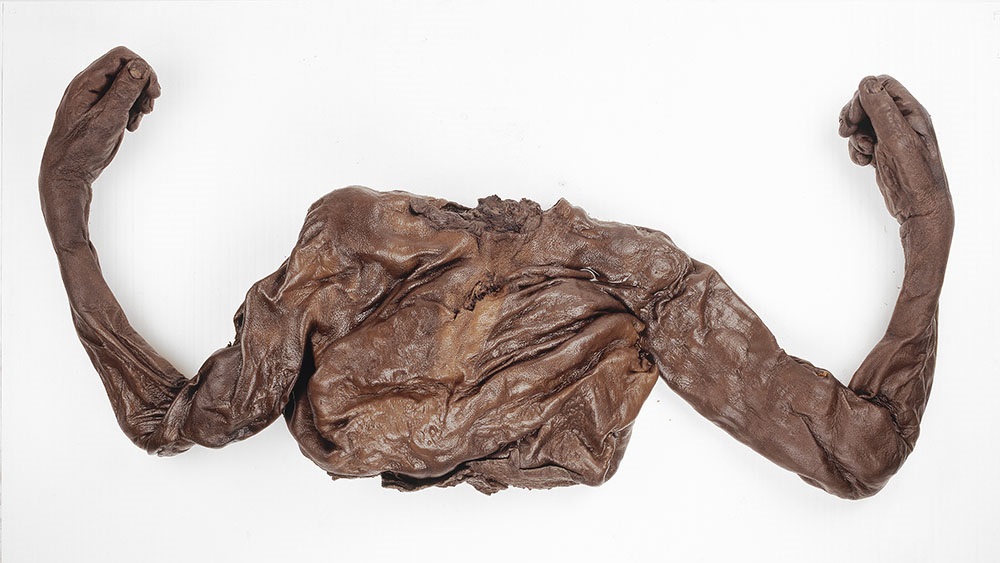
They were cutting a drainage trench through a black Irish bog when the blade of the machine snagged on something that was not a root, not a branch, not a stone. It was an arm. A human arm — the skin tanned to dark leather, the fingers still curled, the nails still neatly trimmed, as if the man they belonged to had been waiting, just under the surface, for someone to come back for him.
He had been waiting for about 2,300 years.
This is Old Croghan Man. He has no head. He has no legs. He is, quite literally, half a man — a torso ending in cuts where the rest of him should be. And almost everything about that ruined body points to a single, chilling conclusion: this was no ordinary killing. Someone wanted him dead, and they wanted the way he died to mean something.
Half a man in the black peat
It was 2003 when workers slicing through Croghan bog in County Offaly hit him. Radiocarbon dating later placed him deep in the Iron Age — roughly 362 to 175 BC, more than two millennia ago.
What kept him is the bog itself. Irish peatlands are cold, acidic, starved of oxygen — a chemistry that refuses to let things rot. Skin tans instead of decaying. Soft tissue holds. So while most of Old Croghan Man was gone, what remained came up almost obscenely intact: leathered skin, muscle, internal organs still in place, and two hands so perfectly preserved that researchers could lift his fingerprints, 2,300 years after his heart stopped.
He was enormous for his time — an estimated 6 feet 3½ inches (1.91 m) of bone and muscle, with thick, powerful arms. And still wrapped around one of them: a plaited leather armband studded with metal mounts in fine Celtic ornament. Not the band of a servant. The band of someone who stood near the top of his world.
) is a well-preserved Irish [Iron Age](https://en.wikipedia.org/wiki/Iron_Age) [bog body](https://en.wikipedia.org/wiki/Bog_body) found ...](data:image/gif;base64,R0lGODdhAQABAPAAAMPDwwAAACwAAAAAAQABAAACAkQBADs=)
The hands that never knew work
Look at the hands and the story sharpens into something stranger.
They are soft. Unmarked. There are no calluses, no breaks, no grind of a life spent farming, fighting or hauling. The nails are manicured. These are hands that were served — that never gripped a plough or a spade. Whoever this man was, other people did the work. He was, by every sign, an aristocrat. Maybe more than that.
And the more closely the scientists read him, the more the body began to feel less like a victim of crime and more like the centre of a ritual.
Fed like a king — then a beggar’s last meal
A body, it turns out, keeps receipts. Chemical analysis of his fingernails revealed that for the four months before he died, Old Croghan Man ate a diet heavy in meat — the food of the rich, the powerful, the well-kept. For months, someone was feeding this man like royalty.
Then they opened his stomach.
His final meal was nothing like the life written into his nails. It was plain and poor: cereals and buttermilk — peasant food, the opposite of the feast he’d been living on. The contrast is jarring, and it hints that he died in the lean season, late winter or early spring, before the land gave up fresh food. Some go further and wonder whether that humble last meal was itself part of the rite — the final, deliberate stripping-away before the end.
Picture it. Months of feasting like a god. And then, on his last day, the food of the lowest in the land. As if he were being slowly turned from a king into an offering.
A death dressed as a ceremony
When the end came, it was savage — and staged.
He was stabbed in the chest, a wound researchers believe was the killing blow. But he didn’t go quietly: a deep slash across one arm is a classic defence wound, the mark of a man throwing up his hand to stop a blade he could see coming. He fought. It wasn’t enough.
And then his killers kept going, long past the point of death. He was decapitated. His torso was cut clean away from his lower body. And through fresh incisions in his upper arms they threaded twisted ropes of hazel — withies — and used them, it seems, to pin his body down into the bog, holding him beneath the black water as if to stop him from ever rising again.
This was not rage. Rage is fast. This was patient, procedural, almost liturgical — a death performed step by step, like a sentence being carried out.
Fed like a god, killed like a warning, and pinned beneath the bog for 2,300 years — Ireland still doesn’t know his name.
The cut that unmade a king
But the detail that stops every expert cold is smaller, and somehow worse than all the rest. His nipples had been cut.
Why mutilate a dying man there? According to Eamonn Kelly, former Keeper of Irish Antiquities at the National Museum of Ireland, the answer reaches back into the strange heart of ancient Irish kingship. In early Irish tradition, sucking a king’s nipples was a gesture of submission — an act that acknowledged his right to rule. A king’s nipples were, in a sense, sacred to his sovereignty.
So to slice them away was not random cruelty. It was, the theory suggests, a deliberate, symbolic act — a way to make the man permanently, irreversibly unfit to be king. You cannot pledge yourself to a ruler whose nipples no longer exist to honour. In Kelly’s reading, Old Croghan Man was a king, a contender for the throne, or a royal hostage — and someone destroyed not just his life but the very thing that made him a king at all.
It is, of course, a theory and not a verdict. The bog can’t testify. But laid against the body — the noble hands, the kingly diet, the ceremonial wounds — it fits with a precision that’s hard to shake off.
A king fed to the goddess?
Kelly’s larger idea is darker still. He has argued that many of Ireland’s bog bodies weren’t criminals at all, but failed or sacrificed kings, given to a fertility goddess to keep the land and its harvests alive — and placed, pointedly, on boundaries.
Old Croghan Man fits that grim template too. He was found along a parish line that traces an ancient border between two early territories — and close to Croghan Hill, the very place where the over-kings of the Uí Failghe were once inaugurated. Some suspect the withies that staked him into the bog were more than restraints: that they invoked a protective taboo, binding his ruined body to guard the boundary forever.
A sacred hill. A border between kingdoms. A man with the hands of a prince, the diet of a god, and the wounds of a deposed king. Whether he failed his people, threatened a rival, or was chosen as the price the land demanded, the bog did not receive him as a corpse. It received him as something far heavier.
What the bog still remembers
Here is what makes Old Croghan Man impossible to forget. It isn’t the gore. It’s the intimacy. We will never know his name — but we know the shape of his fingernails. We know he was pampered for months and then fed like a pauper. We know he raised his arm against the knife. We know that even after he was dead, someone kept cutting, kept arranging, kept making sure.
Two thousand three hundred years later, the bog finally let him go — and handed us a riddle it has no intention of solving for us. So sit with the question the peat won’t answer: was Old Croghan Man a king punished for failing his kingdom… or a life chosen, fattened, and offered up so that the land itself could live?