The “Scorpion King” sounds like something from a movie. As it turns out, a creature that fits the name really did exist — and it was crawling across the Earth roughly 415 million years ago, long before the first dinosaur ever drew breath.
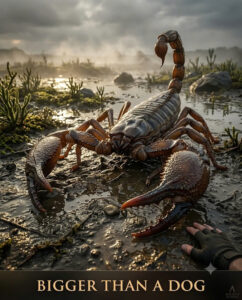
Scientists have now identified it as Praearcturus gigas, and the headline number is hard to take in: this scorpion-like predator may have grown to around a metre long — close to the body length of a fully grown German shepherd. Picture a scorpion the size of a dog, armed with pincers as long as your forearm, and you start to understand why researchers call it the largest scorpion ever known.
A predator the size of a dog
Most scorpions you could hold in your palm. Praearcturus gigas you would not want to meet at all.
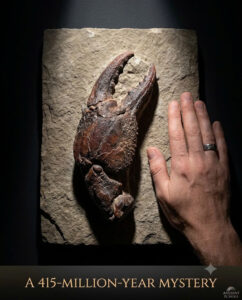
At an estimated metre in length, it would have towered over almost everything else moving on land at the time. Its pincers alone are thought to have measured around 16 centimetres — roughly six inches of crushing claw. On the muddy floodplains where it lived, that combination of size and weaponry would have made it a fearsome apex predator: very likely the most dangerous hunter in its world, with little to fear and plenty to hunt.
To grasp how strange that is, you have to picture the world it ruled.
A giant in a world of tiny things
Step back to the Early Devonian Period, around 415 million years ago, and Earth looks almost unrecognisable. Life had only recently begun its serious push onto land. There were no trees — in fact, the first true forests hadn’t appeared yet. The landscape was low, wet and green with primitive plants, threaded by rivers and floodplains. And the animals creeping through it were, for the most part, small: early arthropods, the ancestors of insects, spiders and crustaceans, most of them no bigger than your finger.
Into that miniature world strode a metre-long monster.
That mismatch is exactly what makes the discovery so important. “What makes Praearcturus so interesting is that it became enormous at a time when life on land was otherwise very small,” said Russell Garwood, a palaeontologist at the University of Manchester and co-author of the study. “But it was a world that could somehow support a giant predator.”
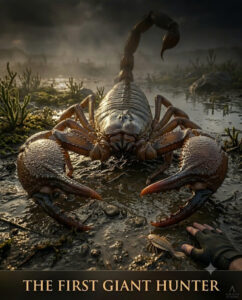
Long before the first dinosaur — before the first forest — a metre-long scorpion may already have been the deadliest hunter on land.
A fossil that baffled scientists for 150 years
Here’s the twist: we’ve actually had pieces of this creature for over a century — we just had no idea what they were.
The first fragments of Praearcturus gigas were dug from the ancient red rocks of England and Wales back in the 1870s. They were strange, broken, and stubbornly hard to read. Early researchers looked at them and guessed they belonged to some kind of giant woodlouse-like crustacean — a massive relative of the little armoured bugs you find under damp logs.
That idea never quite stuck. In the 1980s, other scientists proposed something far more dramatic: that the fossils were the remains of a giant scorpion. But that claim was promptly challenged, and for a good reason — the known fossils were fragmentary, and crucially, they were missing the long curved tail that is a scorpion’s signature feature. Without that tail, no one could be sure. The animal hovered for decades in a kind of taxonomic limbo, too incomplete to identify with confidence.
“Praearcturus has puzzled us palaeontologists for more than a century,” Garwood admitted.
How they finally cracked the case
The breakthrough, published in June 2026 in the journal Palaeontology, came from going back to the original bones with twenty-first-century eyes.
A team led by Richard Howard, curator of fossil arthropods at the Natural History Museum in London, re-examined key specimens held in the museum’s collections using modern imaging and analytical techniques. They compared the fragments closely with other fossil arthropods — including newly described animals that scientists were now confident were scorpions. They also gathered scattered specimens from the same rock formation and recognised that several of them belonged to the same giant creature.
Piece by piece, the picture sharpened. The team concluded that Praearcturus gigas is most likely a scorpion after all — finally tipping a 150-year-old argument toward an answer.
“Confirming that this animal is a scorpion fundamentally changes our understanding of how and when these creatures evolved to such extraordinary sizes,” Howard said. The detective work, Garwood added, let them “build a clearer picture of the animal than was previously possible, which is really exciting.”
Half hunter, half swimmer?

The fossils held one more surprise. Some specimens preserve flap-like structures called epimera — features similar to those that support and protect the shells of modern lobsters and crabs. To the researchers, that hinted at something unexpected: this giant may have been at least partly aquatic, able to move between water and land.
It’s a clue that may also help explain its monstrous size. Water helps support a heavy body, taking some of the strain that land and gravity would otherwise impose — which can make it easier for an animal to grow large. “Without complex ecosystems to support Praearcturus on land, these animals probably spent part of their lives hunting in water,” Howard suggested. Add to that the relative lack of competition from other big land predators, and you have a recipe for runaway gigantism: a creature free to grow huge simply because nothing was stopping it.
So… did it have a venomous sting?
This is the question everyone wants answered — and it’s where honesty matters. We picture scorpions with that arched tail and venomous barb, and the scorpions alive today are indeed venomous. But here’s the catch: the tail and stinger of Praearcturus gigas have never been found. That missing tail is the very thing that made the animal so hard to identify in the first place.
So while it’s tempting to imagine a metre-long scorpion wielding a dagger of venom, the fossils simply don’t tell us. It may have had a powerful sting like its modern cousins — or its weaponry may have been all in those huge crushing pincers. For now, the business end of the Scorpion King remains, fittingly, a mystery.
Why a 415-million-year-old scorpion still matters
It’s easy to be dazzled by dinosaurs. But Praearcturus gigas tells a deeper, older story — one about how life first learned to be big on land.
Millions of years before any dinosaur, giant arthropods like this were already experimenting with size and dominance, ruling wet green worlds we can barely imagine. Studying them helps scientists understand how gigantism evolves, how early predators rose, and how completely the cast of Earth’s “monsters” has changed over deep time.
And there’s a humbler thrill in it too: the reminder that astonishing creatures can sit unrecognised in museum drawers for 150 years, waiting for the right technology — and the right question — to reveal them.
So here’s the thought to carry away: if a metre-long scorpion could hide in plain sight for a century and a half, mislabelled and overlooked, what other giants are still waiting, quietly, in the rocks beneath our feet?