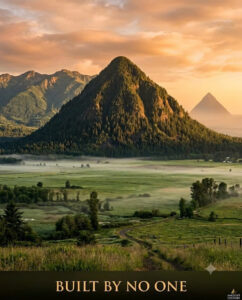
For a few miles, the land in northern Clark County, Washington, lies as flat as a table — old farm fields and fence lines spread across the wide calm of Chelatchie Prairie. Then the horizon does something it has no business doing. It lifts into a single, near-perfect cone, its slopes rising at angles so clean and so balanced that, for one disorienting heartbeat, your brain skips the obvious explanation and reaches for a stranger one: someone built that.
It stands roughly 1,400 feet above the prairie — a green-black pyramid set down in the rain-soaked Pacific Northwest, as though a fragment of ancient Egypt had been mislaid in the wrong climate. And yet no architect ever drew it, no laborer ever stacked it. This is Tumtum Mountain, and the real mystery isn’t who made it. It’s why nothing made it look so much like it was made.

A pyramid on the prairie
Most mountains sprawl, fracture, or pile into messy ridgelines. Tumtum does none of that. It rises almost entirely alone, a tidy symmetrical cone topping out at 2,004 feet (611 metres) — and its isolation is exactly what makes it uncanny. With no jagged neighbours crowding in, there is nothing to look at but the shape. And the shape looks engineered.
Travellers have remarked on it for generations: the way it interrupts the flatland like a deliberate monument, the way the slopes seem too even to be an accident of nature. Catch it from the right angle on the open prairie and the resemblance to a built pyramid grows so insistent that coincidence stops feeling like enough of an answer.
70,000 years young — the baby of the Cascades
The truth is written in the rock — specifically in a fine, pale-grey stone called dacite, the very same family of lava that builds the domes of nearby Mount St. Helens.
Tumtum Mountain is a volcano. More precisely, geologists describe it as a late-Pleistocene dacite lava dome, part of the great chain of fire known as the Cascade Volcanic Arc. A dome like this doesn’t form from rivers of runny lava. It grows from thick, pasty magma — so stiff it can barely flow — that pushes up and piles around its own vent, stacking layer on sticky layer into a steep mound. Pile it evenly enough, for long enough, and you can end up with something that looks disconcertingly intentional.
And it is young — astonishingly young. At roughly 70,000 years old, Tumtum is believed to be the youngest volcano in Washington’s Cascades, and the westernmost as well, standing out ahead of the main volcanic line like a scout sent forward from the ranks. In the lifetime of a planet, 70,000 years is barely a breath. This “pyramid” was still taking shape while the last Ice Age gripped the world.
The mountain named “Heart”
Long before any road pointed toward it, the people of this land already had a name for the cone on the prairie. In Chinook Jargon — the trade language once spoken across the Pacific Northwest — tumtum means “heart.” Some say it carried the fuller sense of a heartbeat: the steady thudding you can feel in your own chest.
Why “heart”? By local tradition, the name may come from the mountain’s outline — not a pyramid in that older reading, but an inverted heart swelling up out of the plain. It is a quietly haunting idea: that two sets of eyes, in two different eras, looked at the very same hill and saw two different things. One reading finds the cold geometry of a tomb. The other finds the shape of something alive and beating.
One people looked at this hill and saw a heart. Others see a pyramid. The mountain has never told us which is right.
The “pyramid” illusion — why it looks built
Here is the puzzle that lodges Tumtum in the memory of nearly everyone who passes it: why should a 70,000-year-old pile of lava look so much like the work of human hands?
Much of the answer, those who study perception suggest, lies not in the mountain but in us. The human brain is a relentless pattern-finder, tuned over millions of years to spot order, symmetry and intention — and sometimes to find them where none exist. A clean triangular silhouette trips ancient wiring: a broad base narrowing to a single point reads instantly as stable, crafted, meant. It is the same instinct that lets us see faces in clouds and figures in the dark — a tendency scientists call pareidolia.
So when Tumtum’s symmetry lines up just right, the mind grabs the nearest familiar template — and across human culture, that template is the pyramid. Egypt, Nubia, Mesoamerica: people have raised pyramids on nearly every inhabited continent, until the shape itself became a kind of shorthand for someone was here. Tumtum quietly hijacks that shorthand. It wears the outline of human ambition while hiding a core of nothing but volcanic rock.
So what is it really?
To a geologist, there’s no riddle at all. Tumtum Mountain is a textbook lava dome: its symmetry the natural outcome of thick magma stacking around a single vent, its grey dacite a near-twin of the rock at Mount St. Helens, its modest height the work of pressure and time rather than design. The science is calm, and it is clear. No credible evidence suggests human hands ever shaped it.
And yet the feeling refuses to go quietly. People have always been drawn to “pyramid mountains” — natural peaks scattered around the planet that look too perfect, too placed, too purposeful — and Tumtum belongs to that strange club of landforms that blur the line between geology and architecture. The wonder here isn’t that it might be a secret monument. The wonder is subtler, and in a way much larger: that nature, given enough fire and enough time, can sculpt something our deepest instincts insist must have been built.
Which leaves a question that lingers long after the cone slips back below the horizon. If a mountain can look this much like a monument with no architect, no blueprint and no purpose at all — how often do we read intention into a world that was simply shaped, patiently, by forces that never meant anything by it?
Why it still haunts the horizon
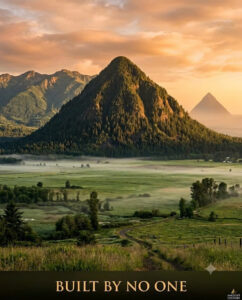
Today Tumtum Mountain is a quiet landmark, a green cone resting in the wider shadow of Mount St. Helens — familiar to locals, all but unknown to everyone else. You can hike it. You can photograph it. You can drive past it on an ordinary afternoon and never think twice.
But try, just once, to meet it the way a traveller might have two centuries ago: stepping out of the trees onto open prairie and finding that impossible, perfect triangle with no explanation in hand. Feel the small electric jolt of recognition — the gut certainty that something so orderly had to have been made. That jolt is the real artifact here. Not the rock. The reaction.
So the next time someone insists a perfect shape is proof of a builder, remember the heart-shaped volcano on Chelatchie Prairie: 70,000 years old, raised by nothing but pressure and patience — and still, to this day, quietly fooling the human eye into hunting for a tomb inside a mountain that was never anything but alive.