When the archaeologists eased into the sealed chamber beneath the Turkish town of İznik, the painted walls had been waiting in the dark for some seventeen centuries. And there, on the wall directly behind the stone bed where the dead were laid, a young man looked back at them — beardless, calm, a horned goat slung across his shoulders.
It is, researchers say, one of the oldest surviving ways anyone ever pictured Jesus. And it looks almost nothing like the bearded, solemn figure most of us carry in our minds. This is the “Good Shepherd” of Nicaea — and the story of why early Christians painted their saviour as a teenage herdsman with a goat is stranger, and more human, than the image itself.

A face behind the tomb wall
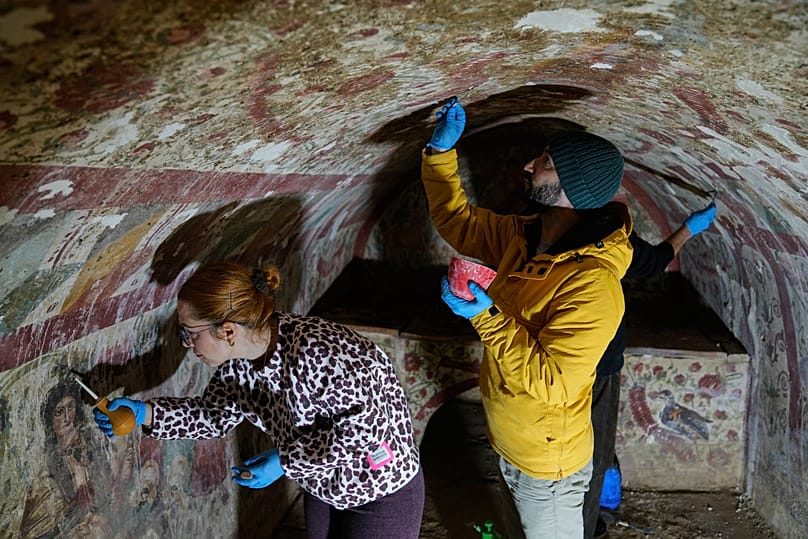
The discovery came during the 2025 excavation season at the Hisardere Necropolis, on the edge of the ancient city of Nicaea — modern İznik, in Türkiye’s Bursa province. Working under the Turkish Ministry of Culture and Tourism, a team led by İznik Museum director Tolga Koparal, with scientific coordination by Professor Aygün Ekin Meriç of Dokuz Eylül University, opened a painted chamber tomb unlike anything else found there.
Most painted tombs in the region carry only patterns — vines, flowers, geometric borders. This one had people. Its three surviving walls and ceiling are covered in frescoes: a banquet scene with two reclining figures, birds, and dense floral motifs. And along the north wall, behind a raised platform called a kline — laid with square terracotta slabs where the body once rested — sat the image that stopped everyone: the Good Shepherd.
It is, the team believes, the only known Good Shepherd scene in all of Anatolia, and the first depiction of Jesus ever identified in this necropolis. For a region soaked in Christian history, that is no small thing.

Jesus as a young shepherd — not the face we know
Look closely and the surprises multiply. The figure is young and beardless, dressed in a plain tunic, rendered in a distinctly Roman style. Across his shoulders he carries a large horned goat; on either side, pairs of goats graze in a neat, symmetrical arrangement. There is no halo, no throne, no crown, no cross. Nothing announces him as divine.
If you expected the familiar Jesus — bearded, robed, gazing out from a golden mosaic — this is a jolt. That iconic image came later. In the earliest centuries of Christian art, Christ was far more often shown exactly like this: a beardless youth, a shepherd, a gentle figure borrowed from the everyday world of the ancient Mediterranean. Artists of the day reached for the visual language they already had — the smooth-cheeked young men of classical sculpture, the calm faces of gods and philosophers — and quietly repurposed it. The long-haired, bearded Christ we picture today would only harden into the standard image over the following centuries, as the faith grew powerful and its art grew grand.
Before Jesus became the bearded king of golden mosaics, he was a young shepherd with an animal on his shoulders — an image quiet enough to hide inside a tomb.
Why a goat, and why no beard?
The “Good Shepherd” wasn’t a random choice. It reaches straight back to the Gospels — to the parable in John 10, where Jesus calls himself the good shepherd who lays down his life for his sheep, and to the lost sheep of Luke 15, carried home rejoicing on the shepherd’s shoulders.
But here is the clever, almost secretive part. The motif of a young man carrying an animal on his shoulders was already ancient in the Greco-Roman world, long before Christianity. The Greeks had the kriophoros — the “ram-bearer” — a stock image of piety and care. So to a Roman passer-by in the third century, a beardless youth with a goat looked like ordinary classical decoration. To a Christian, it meant everything. The same picture could be read two completely different ways — and that ambiguity, the evidence suggests, was the point.

A secret sign in a dangerous time
To understand why that mattered, remember when this was painted. The tomb dates to the third century AD — a time when Christianity was still illegal across much of the Roman Empire, and believers faced waves of persecution. To declare your faith too openly could cost you everything.
So early Christians spoke in pictures that could pass unnoticed. A shepherd. A fish. A meal. Images warm and innocent on the surface, freighted with meaning for those who knew. The Good Shepherd was perhaps the safest of all: a tender, unthreatening figure that let a grieving family place their hope for the afterlife on a tomb wall without ever naming the name that might endanger them. Seen this way, the beardless youth in the İznik tomb isn’t just art. It’s a coded act of devotion, painted in a moment when devotion was risky.
The town that would change Christianity forever
And the location turns the whole thing poignant. Nicaea is not just any ancient city. Within a few decades of this fresco being painted, in AD 325, it would host the First Council of Nicaea — the great gathering of bishops, convened under the emperor Constantine, that produced the Nicene Creed and helped define the core of Christian belief for the next seventeen centuries.
Sit with that timeline. When the shepherd was painted, Christianity was still a hidden, hunted faith whispering in symbols on tomb walls. A generation or two later, in the very same town, it would step into the open and be shaped into the official religion of an empire. This quiet fresco belongs to the before — a glimpse of the faith while it was still a secret, in the place where it would soon become history.
How do we know it’s 1,700 years old?
Here honesty matters. No coins, lamps or grave goods suitable for direct dating were recovered from inside the chamber. Instead, archaeologists dated the tomb by its architecture — its structure and building style closely match other tombs already documented in the same necropolis, which point to the third century. It’s careful, comparative reasoning rather than a precise scientific clock, and the researchers are clear about that. Further study may yet sharpen the date.
That caution is worth keeping in mind whenever a “1,700-year-old” headline appears. The figure is a well-founded estimate — but the tomb still holds questions, and the work of reading it has only begun.
Why a beardless shepherd still matters
We tend to assume the image of Jesus has always looked the way it does on our walls and screens. The İznik fresco gently corrects us. It shows a moment when the face of the most painted figure in human history was still unsettled — when he could be a curly-haired youth with a goat, indistinguishable at a glance from a pagan farm boy.
That’s the quiet power of this discovery. It isn’t just a beautiful old painting; it’s a window into a generation of people who believed something dangerous, expressed it in disguise, and buried their dead in its comfort — right before their hidden faith stepped into the light and changed the world.
So here’s the question to carry away: how much of what we picture as timeless and fixed — even a face this famous — was once uncertain, improvised, and hidden in the dark, waiting for someone to find it again?