For longer than our own species has walked the Earth, she lay in the dark.
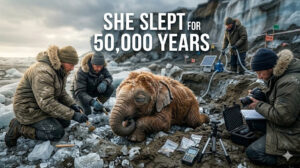
No light. No sound. No seasons. Just the slow, patient grip of the permafrost — a cold so absolute that it stopped time itself. While glaciers advanced and retreated, while the first modern humans crossed into Europe, while empires rose and turned to dust above her, a baby mammoth slept in a tomb of ice, her reddish fur still soft, her tiny trunk still curled to one side, waiting.
Then, in the summer of 2024, the ice let go.

The Gateway to the Underworld
To understand where Yana came from, you have to understand the place that gave her back.
In the Verkhoyansk district of Yakutia — one of the coldest inhabited regions on the planet, in eastern Siberia — there is a wound in the earth. The locals call it the “Gateway to the Underworld.” Scientists call it the Batagaika crater, the largest permafrost crater in the world, a kilometre-long gash that widens a little more every year as the frozen ground beneath it collapses.
It is not a quiet place. The Batagaika groans. Walls of ancient mud and frozen sediment shear away and tumble downward, exposing layers of time that have not seen daylight in hundreds of thousands of years. Bones surface here. So do tusks, frozen plants, and the occasional carcass of a creature that the modern world has only ever seen as a skeleton in a museum.
In the summer of 2024, as the thawing cliff face crumbled and bled meltwater, something small and dark began to emerge from the wall of ice.
What the Thaw Revealed
At first, the locals who spotted it thought they were looking at a dead reindeer calf — a small, dark shape with a strange protrusion that might have been a snout. They moved closer. The “snout” was a trunk. The shape had ears. It had the unmistakable, heartbreaking outline of something that should not exist intact: a baby mammoth, melting out of a hillside that had held her since the depths of the Ice Age.
They called the scientists.

Researchers from the North-Eastern Federal University (NEFU) in Yakutsk arrived in heavy cold-weather gear, their breath hanging white in the grey Arctic air. They worked slowly, carefully, with hand tools, easing her free of the frozen sediment that had become her coffin and her cradle. When they finally lifted her out — wrapped against the warmth that was now, suddenly, her enemy — they understood that they were holding something the world had almost never seen.
They named her Yana, after the river basin that had kept her.
A Face From the Ice Age
Yana is a female calf who died at just over one year old. She stands about 120 centimetres at the shoulder, stretches less than two metres from trunk to tail, and weighs over 100 kilograms even now, drained of the life that once filled her.
But the numbers are not what stop you. It is the face.
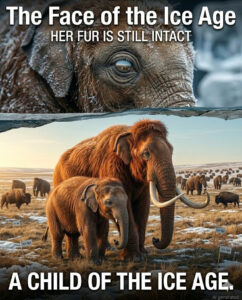
Her head is undamaged. Her trunk is intact. Her ears are still there, and her mouth, and the wrinkled, leathery folds of skin around an eye that never reopened. The reddish-brown fur that mammoths were famous for still clings to her in matted clumps, softened by the meltwater that finally released her. NEFU’s scientists did not hedge their words: Yana, they said, is the best-preserved baby mammoth in the world.
She is only the seventh baby mammoth carcass ever recovered on the entire planet — six from the Russian permafrost, one from the Yukon in Canada. Each one is a near-miracle of preservation, a creature snatched out of deep time before decay could erase it. Yana is the finest of them all.
Look at her and the distance of 130,000 years simply collapses. This is not a monster. This is a baby — no different in her vulnerability from a modern elephant calf, an animal that would have depended utterly on her mother for warmth, for milk, for protection from the cave lions and giant bears and wolf packs that hunted the frozen steppe.
The Mystery of How She Died

Here is where the science becomes detective work.
A body does not survive 130,000 years by accident. For soft tissue, fur, and skin to endure, decomposition must be stopped almost the instant life ends — which means Yana was buried fast. The leading theory reads like the final scene of a tragedy: a young calf, perhaps separated from the herd, stumbling into a mud pit, a bog, or a hidden crevasse. Trapped. Sinking. Sealed away by mud and cold before the bacteria of decay could even begin their work.
Whatever killed her also saved her — froze her at the exact moment of her death and held that moment perfectly still for longer than human memory can stretch.
50,000 Years… or 130,000? The Number That Stunned the Scientists
When Yana was first unveiled to the world in December 2024, researchers estimated her age at over 50,000 years — already an astonishing figure, old enough to predate written history a hundred times over.
Then they studied the permafrost layer she had been entombed in more closely. The number changed. Yana, they concluded, may be more than 130,000 years old.
Pause on that. When Yana last drew breath, Homo sapiens had barely begun to spread out of Africa. The world she knew — the vast, grassy “mammoth steppe” that stretched from Siberia to North America — has been gone for so long that the tundra and taiga which replaced it now feel ancient themselves. She is not a relic of human history. She is older than almost all of it.
What Yana Is Trying to Tell Us
A find this complete is not just a marvel — it is a library.
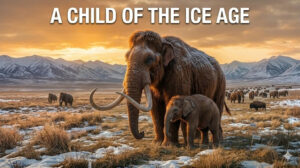
In the spring of 2025, Yana was carefully taken in for a full scientific examination, going quite literally under the scalpel. Researchers can now read her like a manuscript written in flesh. Her preserved DNA may reveal how mammoths adapted to the brutal cold of the Pleistocene. The contents of her stomach can tell us what a baby mammoth ate — and, by extension, what grew on a landscape that no longer exists. The isotopes locked in her fur can trace where her herd wandered across that vanished world.
Each of these threads pulls the Ice Age a little closer, turning a frozen body into a window onto an entire lost ecosystem — its plants, its predators, its climate, its rhythms of life and death.
The Warning Buried in the Melting Ice
And yet the most unsettling part of Yana’s story is not how she died, or how long ago. It is why she has returned now.
Yana did not climb out of the permafrost. The permafrost let her go — because it is thawing. The same warming Arctic that is widening the Gateway to the Underworld year after year is what surrendered her body to the light. She is a gift to science, yes. She is also a symptom.
If a 130,000-year-old baby mammoth can melt out of a Siberian hillside, the obvious question is the one no one quite wants to ask aloud: what else is in there? Frozen ground holds more than carcasses. It holds ancient carbon, dormant microbes, and a record of a planet that ran on different rules. As it thaws, it gives up its dead — and its secrets — whether we are ready or not.
For now, Yana lies in a laboratory in Yakutsk, far from the herd that once searched a frozen plain for a calf who would never answer. She has been silent for longer than we can truly imagine.
But she is not finished speaking. Forty millennia was the old guess; a hundred and thirty thousand years is closer to the truth. Either way, the baby mammoth has returned to the light — not to live, but to remind us of something we keep forgetting.
Extinction is not ancient history. The ice that hid it is melting in real time. And every creature lost leaves a hole in the world that nothing else will ever fill.
Frequently Asked Questions
What is Yana the baby mammoth?
Yana is a remarkably well-preserved female woolly mammoth calf recovered from the Siberian permafrost in 2024. She died at just over one year old and is considered the best-preserved baby mammoth ever discovered.
How old is the Yana mammoth?
Yana was initially estimated to be more than 50,000 years old. After closer analysis of the permafrost layer where she was found, researchers revised her age to potentially more than 130,000 years.
Where was Yana found?
She was discovered in the Batagaika crater — the world’s largest permafrost crater, nicknamed the “Gateway to the Underworld” — in the Verkhoyansk district of Yakutia, eastern Siberia. She is named after the nearby Yana River.
Why is Yana so important to scientists?
She is only the seventh baby mammoth carcass ever found worldwide and the best-preserved. Her DNA, stomach contents, and fur can reveal how mammoths lived, what they ate, and what the Ice Age environment was like.
What does Yana’s discovery tell us about climate change?
Yana emerged because the Arctic permafrost that held her is thawing. Her appearance highlights how rapidly the frozen ground is melting — releasing not only ancient remains but also stored carbon and long-dormant microbes.