Somewhere in the northwestern deserts of Saudi Arabia, far from any city, two enormous slabs of sandstone stand alone against the horizon. From a distance they look like a single massive boulder. But step closer, and you see the thing that has haunted travelers, geologists, and conspiracy theorists alike.
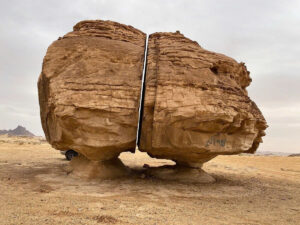
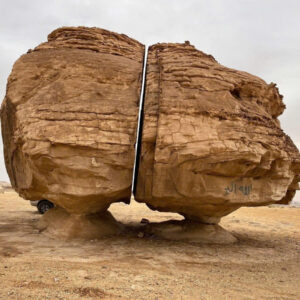
A gap runs straight down the middle of the stone — pencil-thin, ruler-straight, and so impossibly clean it looks as though the entire rock was sliced in two by a single pass of a giant laser.
There are no tool marks. No rubble. No sign of a blade or a chisel. Just two towering halves, each balanced on a slender natural pedestal, separated by a fissure so smooth it seems to defy the laws of erosion. This is Al-Naslaa, and for decades it has been the centerpiece of one of the desert’s most stubborn questions: what on Earth could cut a rock like that?
A Cut That Shouldn’t Be Possible
Al-Naslaa sits roughly 50 kilometers (30 miles) south of the ancient oasis town of Tayma, in a remote and arid stretch of northwestern Saudi Arabia. The formation is modest in size by monument standards — about 6 meters (20 feet) tall and 9 meters (30 feet) wide — but its strangeness has nothing to do with scale.
It’s the precision that stops people in their tracks.
The two blocks are near-perfect mirror images, divided by a gap that runs vertically through the entire stone with the confidence of a laser beam. The faces on either side of the split are smooth and flat. The line barely wavers. And as if the universe were determined to make it look even more deliberate, each half rests on a small, sculpted base — giving the whole formation the eerie impression that it’s floating just above the desert floor.
Stand in front of Al-Naslaa and your brain rebels. Every instinct says this was made. Designed. Cut. The symmetry feels too intentional to be an accident of wind and time. And that single, screaming question — how? — is exactly what has turned a remote desert rock into a global obsession.

The Theories That Refuse to Die
Where there is mystery, legend rushes in to fill the silence.
For years, Al-Naslaa has been a magnet for spectacular explanations. Some insist it’s evidence of a lost ancient civilization — a people far more advanced than our history books admit, armed with stone-cutting technology we’ve somehow forgotten. Others go further, whispering about laser tools, directed energy, even visitors from beyond the stars. After all, the reasoning goes, how could a primitive desert culture, or blind natural chance, produce a cut this surgical?
The rock seems to taunt skeptics. Its precision is the kind of detail that fuels late-night documentaries and viral posts shared millions of times, each one asking the same intoxicating question: what if the official story is wrong?
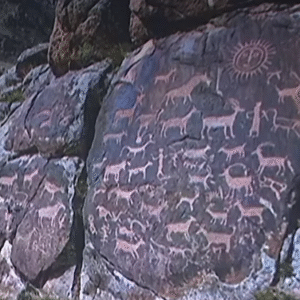
And then there are the carvings. Al-Naslaa’s surface is covered in ancient petroglyphs — images of horses, ibex, and human figures etched into the stone by people who lived here thousands of years ago. To the imaginative eye, those engravings feel like a clue, proof that someone was here, working the rock, leaving messages. Surely, the theory goes, the same hands that carved the horses also cut the stone in two?
It’s a seductive story. It’s also, almost certainly, wrong. Because the truth about Al-Naslaa is, in its own quiet way, even more astonishing than the legend.

The Stranger, Truer Story
Here is the twist that the laser theories leave out: geologists who have studied Al-Naslaa overwhelmingly agree that no human, and no machine, made that cut. The split is natural. The petroglyphs were carved long afterward, by people who simply found a dramatic rock and decorated it — the art and the fracture have nothing to do with each other.
But “natural” does not mean simple. To produce something this clean, nature had to pull off a sequence of events so precise it can feel almost choreographed.
It likely began deep below the surface. Sandstone is a layered, relatively fragile rock, threaded with hidden lines of weakness. One leading explanation is that Al-Naslaa sits in a region that occasionally experiences tectonic movement — and that a shift in the Earth’s crust placed stress on the boulder, snapping it along one of those weak internal seams. In geology, a clean break like this, where rock fractures without the two sides sliding past each other, is called a joint — and joints are famous for splitting stone along startlingly straight lines.
That single fracture was just the opening act. What turned a rough crack into a polished, laser-straight gap was thousands of years of patient sculpting by the desert itself.
Why the Line Is So Impossibly Straight

Once the rock had split, the wind took over — and this is where Al-Naslaa’s secret really lives.
A narrow gap in a boulder behaves like a funnel. Desert winds, heavy with fine sand, were channeled through that opening and accelerated as they squeezed between the two halves. For millennia, that abrasive, sand-laden air blasted away at both inner faces like a natural sandpaper, smoothing and straightening the divide far beyond what a simple crack could ever produce. The more the wind polished, the cleaner the line became.
Some scientists add another character to the story: water and ice. If water seeped into the original cracks during cooler, wetter periods of the region’s history, it could have frozen, expanded, and pried the fractures wider — a slow, relentless process called freeze-thaw weathering. As small cracks linked up and the ice eventually melted away, the two halves were left standing apart.
And those uncanny pedestals that make Al-Naslaa look like it’s levitating? They’re natural too. Formations like this are sometimes called “mushroom rocks,” and they’re surprisingly common in deserts. Wind blows faster and carries more sand a little higher off the ground than it does right at the surface, so the lower portion of a boulder erodes more slowly — leaving a wider block perched on a slimmer base.
Put it all together — a fragile, layered stone; a clean tectonic joint; a wind-funneling gap; and tens of thousands of years of sand and ice — and you get a sculpture that looks engineered but was authored entirely by physics. Nature, it turns out, is the most patient stonemason of all.
The Forgotten Artists of Tayma
Strip away the lasers and the aliens, and Al-Naslaa still has a genuine human mystery left to offer — one that’s often overlooked because the split steals all the attention.
The petroglyphs.
Carved into the rock’s southeastern face are images of Arabian horses, ibex, and people, the work of communities who lived in this region thousands of years ago. They are real, ancient, and quietly profound — a record of a desert that was once far more alive with people and animals than the empty horizon suggests today. The land around Tayma was a thriving oasis on ancient trade routes, and these engravings are fingerprints of that vanished world.
Yet their exact age remains genuinely unknown. Researchers can say the carvings are thousands of years old, but pinning down precisely when — and exactly who made them — is still an open question. So while the “laser cut” is a mystery that science has largely solved, the human story written on Al-Naslaa’s surface is a riddle that lingers. The real enigma was never how the rock was split. It was the forgotten hands that chose this strange, divided stone as their canvas.
Why Al-Naslaa Still Haunts Us
There’s a reason this rock refuses to leave the internet’s imagination. Al-Naslaa sits exactly on the fault line between what looks impossible and what is merely rare — and that’s the most unsettling place of all.
It teaches an uncomfortable lesson: our instincts about what nature “can” and “can’t” do are not always trustworthy. Faced with perfect symmetry, the human mind reaches instinctively for a designer, a maker, a secret. We are pattern-seeking creatures, and a ruler-straight line in the middle of a wild desert feels like a message meant for us.
But the deeper truth is arguably more humbling than any ancient-laser fantasy. No lost civilization was needed. No visitors from the stars. Just wind, water, stone, and an almost unimaginable amount of time, conspiring to produce something that looks, to our eyes, like the work of a master craftsman.
Al-Naslaa is a monument — not to a forgotten technology, but to the quiet, relentless artistry of the Earth itself. And maybe that’s why we keep coming back to it. Because the real mystery isn’t who cut the rock.
It’s how nature, given enough time, can make the accidental look utterly intentional.
Frequently Asked Questions
What is the Al-Naslaa rock formation? Al-Naslaa is a sandstone rock formation in the desert near the Tayma oasis in northwestern Saudi Arabia. It’s famous for being split cleanly down the middle by a perfectly straight, smooth gap, with each half balanced on a natural pedestal. It stands about 6 meters (20 feet) tall and 9 meters (30 feet) wide.
What caused the Al-Naslaa rock to split so perfectly? Geologists attribute the split to natural processes. The leading explanation is a natural fracture called a “joint” — possibly triggered by tectonic stress — that broke the layered sandstone along a straight line. Thousands of years of wind-driven sand funneling through the gap, along with possible freeze-thaw weathering, then smoothed and straightened the divide into its laser-like appearance.
Was Al-Naslaa cut by a laser or ancient technology? No. Despite viral theories about lasers, lost civilizations, or aliens, there is no scientific evidence of human or technological cutting. The precision is the result of natural geology and erosion. The clean line is rare, but entirely explainable by physics.
How old is the Al-Naslaa rock? The sandstone itself is geologically ancient, far older than human history. The petroglyphs carved on its surface are estimated to be thousands of years old, though their exact date is unknown. The “4,000 years” figure often cited online refers loosely to the era of human activity in the region, not the age of the rock.
What are the carvings on Al-Naslaa? The rock’s southeastern face holds ancient petroglyphs — engravings of Arabian horses, ibex, and human figures made by people who lived near Tayma thousands of years ago. They were carved long after the rock split and are unrelated to the gap itself.
Where is Al-Naslaa located? Al-Naslaa lies roughly 50 kilometers (30 miles) south of the Tayma oasis in northwestern Saudi Arabia, in a remote desert region once crossed by ancient trade routes.
Sources & further reading: Live Science, Wikipedia, Geology Science, IFLScience, and HowStuffWorks. Petroglyph research documented via the Arabian Rock Art Heritage project and ResearchGate.