“My Name Is Aba”: The 1,000-Year-Old Signature Hidden Among 1,200 Carvings in a Kazakh Gorge

In a remote mountain gorge in southern Kazakhstan, the rock walls are crowded with ghosts. Goats and camels stride across the stone. Hunters draw their bows at prey that died four thousand years ago. For forty centuries, people climbed into this narrow valley, pressed sharp tools to the cliffs, and left behind more than twelve hundred images — a vast, silent gallery scratched into the mountains themselves.
And then, somewhere in that crowd of animals and hunts, archaeologists found five small angular marks that stopped them cold.
They were not a picture. They were words. And when a specialist finally read them, the message that emerged after more than a thousand years of silence was startlingly, almost unbearably, human:
“My name is Aba.”
Not a king’s boast. Not a prayer. Not a record of conquest. Just a person, standing in a mountain pass at the edge of the medieval world, carving the oldest possible message into stone — I was here. This is who I am. And against every odds, we can still read it.
A Stone Archive 4,000 Years Deep
The discovery comes from Burkhansai Gorge (sometimes written Burkhansay), in the Zhualy District of Kazakhstan’s Jambyl Region. There, researchers from the A. Kh. Margulan Institute of Archaeology have documented more than 1,200 petroglyphs — and they’re quick to stress that the count is still preliminary. The gorge is only beginning to give up what it holds.
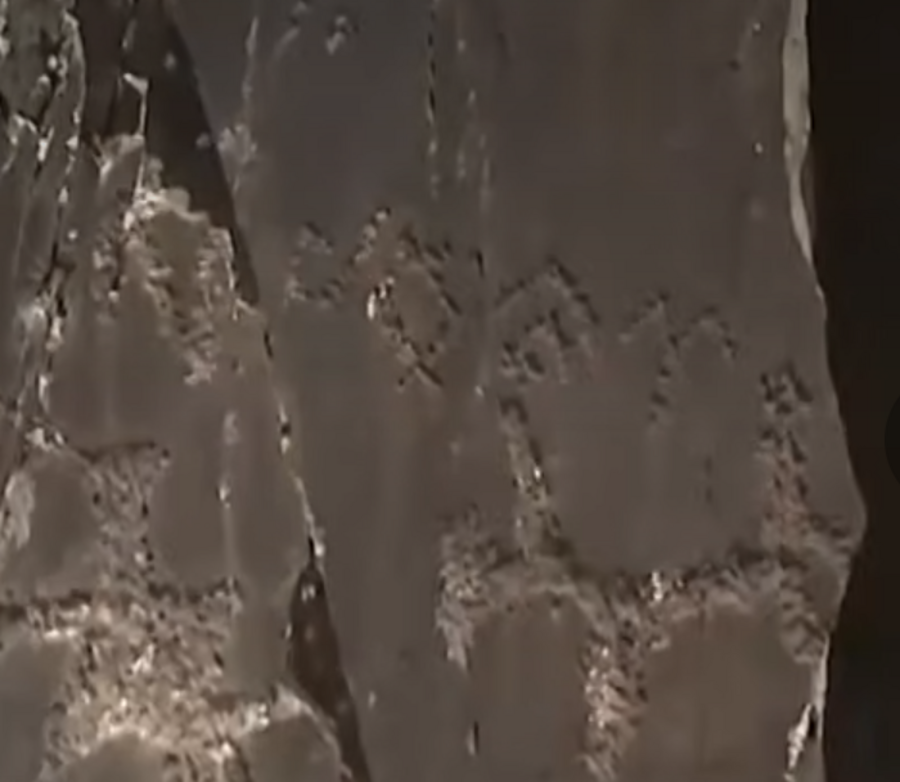
What makes Burkhansai extraordinary is not just the number of carvings, but their depth in time. This is not a snapshot of a single moment. It is what the researchers call a “stone archive,” accumulated and expanded over nearly four thousand years. The earliest images reach back to the end of the third millennium BC, and the carvings continue through the Bronze Age, the Early Iron Age, the Middle Ages, and into more recent centuries. Generation after generation returned to the same rock faces and added their own marks above the older ones.
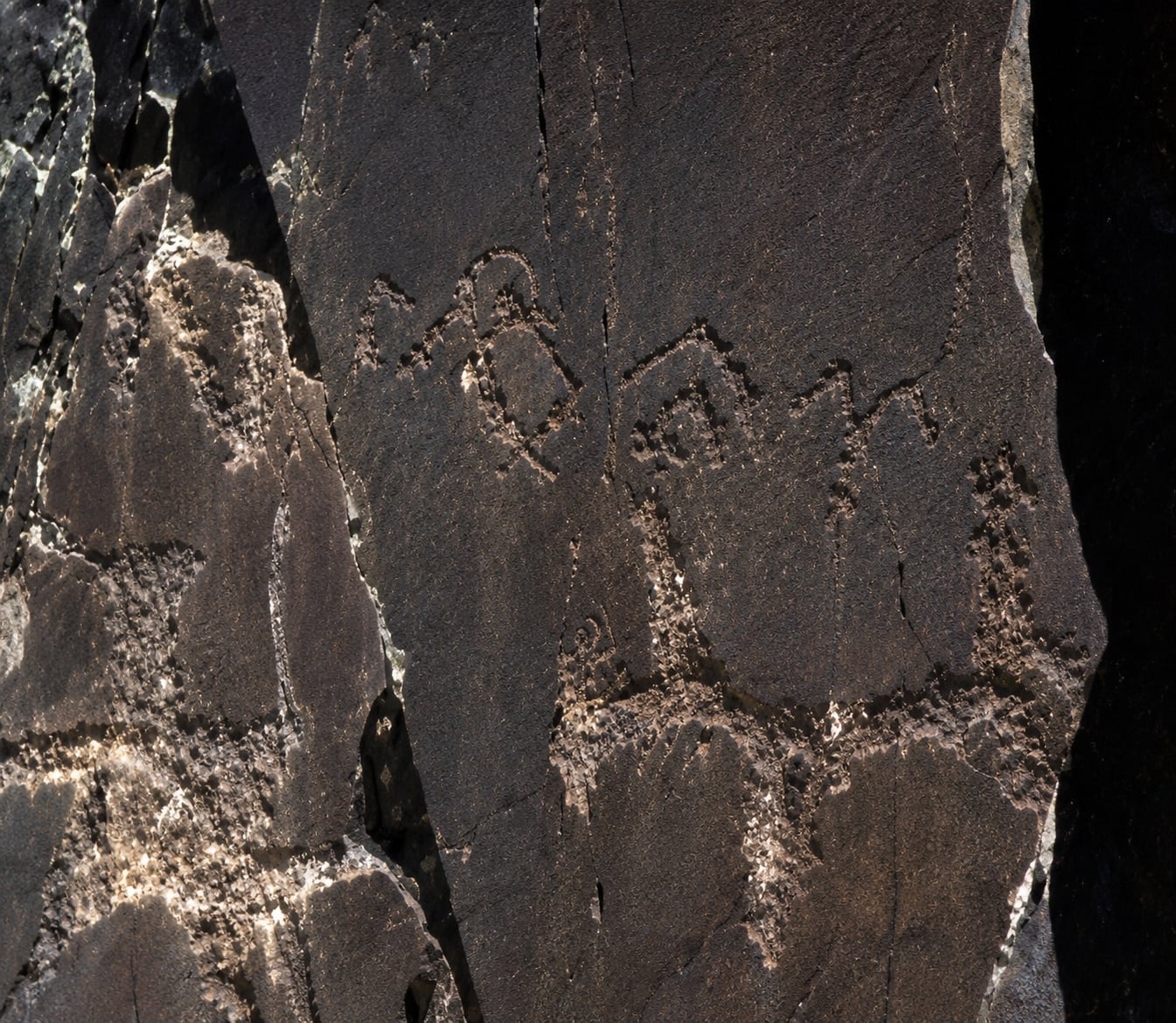
The petroglyphs are arranged in five distinct clusters, strung along the path of a stream as it cuts through the gorge. The most common images are the animals that defined life here: herds of goats, camels, and vivid hunting scenes. To the people who made them, these were never just decoration. Goats spoke to the all-important economy of mountain herding. Camels evoked prosperity, trade, and the long journeys that threaded across Central Asia. And the hunting scenes may have carried ritual or magical weight — images made to summon success in the hunt, pressed into the rock like a wish.
Read together, the carvings sketch a way of life: communities who herded, hunted, and moved through the mountain corridors season after season, for thousands of years.
Five Signs That Say “I Was Here”
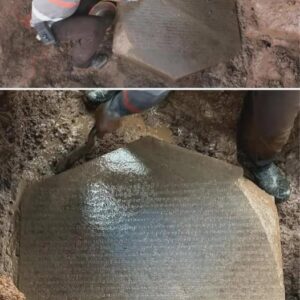
Among all those images, the single most significant find at Burkhansai is also one of the smallest: a short text of just five characters, carved in Old Turkic runic script.
It has been preliminarily dated to sometime between the 4th and 10th centuries AD, meaning it was likely carved more than a thousand years ago. The text was sent to Vladimir Tishin, a recognized specialist in Old Turkic writing, who deciphered it. His reading — “Er atim Aba” — translates to “My name is Aba.”
That brevity is exactly what makes it so powerful. There are no royal titles. No dates. No invocations of gods or kings. Just a name and the simple, defiant act of recording it. In a landscape already saturated with images far older than himself, a single individual chose to add not another animal, but his own identity.
Boris Zheleznyakov, a leading researcher at the Margulan Institute, has called the find rare and important — and he suggests the person who carved it may have been regarded as the owner or guardian of the area, leaving his name on the rock as a statement of presence and belonging. Whoever Aba was, he wanted the mountains to remember him. They did.
Not the Runes You’re Thinking Of

The word “runic” tends to conjure Vikings and Norse sagas — but that’s a misunderstanding worth clearing up. Old Turkic runic script is called “runic” only because of its sharp, angular appearance, well suited to carving into hard surfaces. It is entirely unrelated to the Scandinavian runes of northern Europe, and it developed independently within the Turkic-speaking world.
Most famously, this writing survives in the monumental Orkhon inscriptions of Mongolia — grand stone monuments that commemorated rulers and great political events. Related examples stretch across a huge swath of Eurasia, from the Yenisei and Altai regions to the Talas Valley and parts of Kazakhstan.
The Burkhansai inscription belongs to a particular regional branch known as the Talas script — and that detail matters. The Talas tradition shows how Turkic writing spread and adapted as it moved across Central Asia, taking on local forms far from the imperial monuments of Mongolia. But where the Orkhon stones shout the deeds of kings, Aba’s inscription whispers something far more intimate. As the researchers put it, the find “demonstrates that writing was not limited to rulers and official monuments. It was also used by ordinary people travelling, herding, or living within these mountain regions.”
In other words, this may be a glimpse of literacy not as a tool of empire, but as something an ordinary herdsman could pick up and use — to sign his own name on the world.
A Gorge of the Living and the Dead
The carvings are only part of the story. Burkhansai was not just a wall to draw on; it was a place where people lived, traveled, and buried their dead.
Archaeologists have identified three separate burial grounds in the area — designated Burkhansai 1, 2, and 3 — dating to the Early Iron Age and the medieval period. Their presence transforms our understanding of the site. This was not merely an open-air canvas visited now and then. It was part of a wider cultural landscape: a place used for movement and migration, for burial and remembrance, and very likely for seasonal occupation as herders followed their animals through the mountains.
Picture it across the centuries — a gorge with water, shelter, sweepable rock faces, and natural routes through difficult terrain. For Bronze Age herders, Early Iron Age groups, medieval Turkic speakers, and travelers who came long after, a place like this would remain useful and meaningful generation after generation. Every era left its trace, layering memory upon memory until the whole gorge became a kind of palimpsest of human passage.
The Crossroads That Made It Possible
Why would so many different peoples, across so many centuries, converge on one narrow valley? Geography holds the answer.
The Jambyl Region sits in a historically rich corner of Central Asia, linked to the Talas Valley, the Western Tien Shan mountains, and the ancient Silk Road city of Taraz — one of the oldest urban centers in Kazakhstan. This was a genuine contact zone, where nomadic, pastoral, urban, and trade networks met and mingled over many centuries. Goods, people, languages, and ideas all flowed through this landscape — and a gorge along those routes would have seen a steady procession of humanity.
It helps to set Burkhansai in context. Kazakhstan is home to some of Central Asia’s most important rock-art landscapes, including the UNESCO-listed site of Tanbaly, with its thousands of carvings tied to pastoral communities, ritual, and burial. Burkhansai is not Tanbaly — the two should not be confused — but it fits the same profound pattern: in this part of the world, mountain gorges and river valleys served as long-term cultural archives, holding the memory of everyone who passed through.
So Who Was Aba?
Here is the mystery that lingers after the headlines fade. We have his name. We have, perhaps, his role — an owner or guardian of this stretch of mountains. We even have his handwriting, in a sense, frozen in five angular strokes. But we will almost certainly never know anything else about him.
Was he a herder resting his animals by the stream? A local figure asserting his claim to the gorge? A traveler who knew just enough of the Talas script to leave his mark among images he recognized as ancient even then? We can’t say. And yet the not-knowing is part of what makes the inscription so moving. Stripped of titles and dates and politics, “My name is Aba” is almost pure human impulse — the same urge that drives a child to write their name in wet cement, or a traveler to scratch initials into a wall.
It is a reminder that the deep past was populated not only by kings and armies, but by individuals: people with names, who wanted, just as we do, not to be forgotten.
What Happens Next
The work at Burkhansai has only just begun. Researchers are now studying and classifying the petroglyphs period by period, and they intend to investigate the three burial grounds more fully while searching for associated settlements that could reveal how these communities actually lived in the surrounding landscape.
Once the comprehensive study is complete, the team plans to publish a monograph on both the petroglyphs and the runic inscription — and to propose that the entire complex be placed under state protection, safeguarding it for future study and for visitors.
For now, Burkhansai Gorge stands as a newly documented archaeological complex of unusual depth: a stone archive tracing patterns of hunting, herding, and migration across four millennia. But it’s the smallest mark on its walls that will stay with you. Long after the empires that surrounded him rose and fell, one man’s quiet declaration is still legible on the rock — a name, carved into stone, still answering across more than a thousand years.
My name is Aba. And now, at last, we know it.
Frequently Asked Questions
What was discovered in Burkhansai Gorge, Kazakhstan? Archaeologists from the A. Kh. Margulan Institute of Archaeology documented more than 1,200 petroglyphs spanning roughly 4,000 years, along with a rare Old Turkic runic inscription and three Early Iron Age and medieval burial grounds, in Burkhansai Gorge in the Zhualy District of the Jambyl Region.
What does the Old Turkic inscription say? The five-character inscription reads “Er atim Aba,” meaning “My name is Aba.” It was deciphered by Old Turkic writing specialist Vladimir Tishin and is thought to be a personal mark left by an individual, rather than a royal or official monument.
How old is the “My name is Aba” inscription? It has been preliminarily dated to between the 4th and 10th centuries AD, meaning it is likely more than 1,000 years old. The surrounding petroglyphs are far older, with the earliest dating back about 4,000 years.
What is the Talas script? The Talas script is a regional form of Old Turkic runic writing used in parts of Central Asia. Despite the name “runic,” it is unrelated to Scandinavian runes and developed independently in the Turkic-speaking world. It is part of the same broad tradition as Mongolia’s famous Orkhon inscriptions.
What do the petroglyphs show? The carvings include goats, camels, and hunting scenes spanning the Bronze Age, Early Iron Age, and Middle Ages. These motifs reflect herding, hunting, trade, and the symbolic and possibly ritual life of the nomadic and pastoral communities of Central Asia.
Why is the discovery significant? Burkhansai offers a rare, layered record of human activity across thousands of years in a single landscape, and the inscription provides evidence that literacy in the early Turkic world extended beyond rulers to ordinary people. Researchers plan a monograph and intend to propose state protection for the site.
Sources & further reading: HeritageDaily, Arkeonews, GreekReporter, and The Astana Times. Discovery announced by the A. Kh. Margulan Institute of Archaeology (researchers Anatoly Shayakhmetov and Boris Zheleznyakov); inscription deciphered by Vladimir Tishin. Image credit: A. Kh. Margulan Institute of Archaeology / 24 kz.