Archaeologists working at an ancient cemetery in Egypt have opened two tombs containing not only mummies, but also 9 terrifying “monster” skulls.
The truth about the “grim reaper” near an abandoned mine that caused 37 species of monsters to collapse and die
Shocking: Extinct Madagascar monster shared many human-like traits
Shock at the sighting of a bizarre creature resembling the “Loch Ness monster”
According to Ancient Origins, the “monsters” were identified as ancient Nile crocodiles. They were not mummified, but simply wrapped in cloth and arranged around the deceased as part of a special ritual.
Scientists from the Polish Centre of Mediterranean Archaeology at the University of Warsaw made the unusual discovery while excavating at the el-Asassif necropolis, an ancient burial site located just west of the road leading to the famous Mortuary Temple of Hatshepsut.
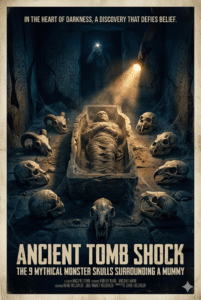
Ancient Tomb Shock: 9 mythical monster skulls surrounding a mummy – Image 1
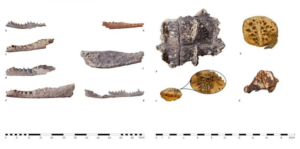
The remains of the “monster” were taken to the laboratory – Photo: Patryk Chudzik
According to Heritage Daily, excavation of the two tombs began in 2013. Preliminary findings showed that one of the tombs belonged to a man named “Cheti,” a high-ranking official under Pharaoh Nebhepetre Mentuhotep II, who ruled from 2055 to 2022 BC.
The identity of the second mummy remains a mystery.
The 4,000-year-old crocodiles in the tomb may not have been regarded as ordinary crocodiles. In mythology, the Nile crocodile and the West African crocodile were seen as manifestations of the god Sobek.
Ancient Tomb Shock: 9 mythical monster skulls surrounding a mummy – Image 2
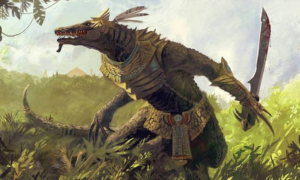 The god Sobek in Egyptian mythology – Photo: Realm of History
Sobek sometimes appeared in the form of a real crocodile, and at other times as a man with a crocodile’s head. He was associated with the strength of the pharaohs, fertility, and military power. He was also considered a protective deity who guarded against dangers posed by the Nile.