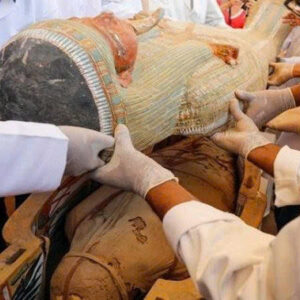
The lamplight moved across the linen first — bandages wrapped in delicate geometric patterns, darkened by two thousand years underground. Then the archaeologists leaned closer to the open mouth of the mummy, and something caught the light and held it.

It was gold.
Where a tongue should have been, there was a thin, gleaming sliver of precious metal, placed with deliberate care inside the mouth of a person who had been dead since the age of the Roman emperors. It had not tarnished. It had not decayed. It had waited, silent and shining, for someone to come and ask the obvious question.
Why would anyone bury their dead with a tongue made of gold?
The answer, it turns out, reaches into one of the most beautiful and unsettling beliefs of the ancient world — and the tomb that held it had one more secret still to give.
A Tomb at the City of Lost Words
The discovery comes from Al-Bahnasa, a site in Egypt’s Minya Governorate that the ancient world knew by a far more evocative name: Oxyrhynchus. Egypt’s Ministry of Tourism and Antiquities announced the find on April 18, 2026, and it was no ordinary dig.
The work was carried out by an Egyptian–Spanish mission from the University of Barcelona and the Institute of the Ancient Near East, a team that has returned to this stretch of desert season after season since 1992. During their most recent campaign, between November 2025 and February 2026, they opened a Roman-era tomb and found it crowded with the dead — mummies wrapped in linen decorated with intricate geometric designs, laid alongside painted wooden coffins.
But it was what lay inside the wrappings, and inside the mouths, that turned a routine season into international news.
Mouths of Gold
Among the artifacts the team recovered were three golden tongues and one of copper — small, tongue-shaped amulets placed directly into the mouths of the deceased. On some of the mummies, archaeologists also found traces of gold leaf applied straight onto the body, a shimmering film meant to transform mortal flesh into something closer to the divine.
These were not careless ornaments. Each gold tongue was a deliberate act of love, faith, and fear — a final gift to prepare someone for the most dangerous journey the Egyptians could imagine. And to understand why a tongue, of all things, you have to follow the dead through the door of death itself.

Why Gold? A Tongue to Speak to the Gods
To the ancient Egyptians, dying was not an ending. It was a trial.
They believed that when a person died, their soul traveled to the Hall of Judgment, where the god Osiris, lord of the underworld, presided over a tribunal of divine judges. There, the heart of the deceased was weighed on a great scale against the feather of Ma’at, the goddess of truth and cosmic order. To pass, the dead could not simply stand in silence. They had to speak — to recite their innocence, to answer the gods, to plead their case for eternal life.
But a corpse cannot speak. The tongue, like all flesh, rots away in the long dark of the tomb. And so the Egyptians devised a solution of breathtaking elegance: if the mortal tongue would fail, they would replace it with one that never could. Gold does not rust, tarnish, or decay. To the Egyptians it was the very flesh of the gods, the imperishable metal of the sun. A tongue of gold would last forever — and so its owner would be able to speak before Osiris not just at the moment of death, but for all eternity.
It is a staggering idea: that someone, two millennia ago, looked at the silence of death and answered it with gold, so that a loved one would never be struck dumb before the gods.
And the people of Oxyrhynchus were not alone in this. Gold-tongued mummies have surfaced elsewhere in Egypt — most famously in 2021, when a sealed tomb at Taposiris Magna near Alexandria yielded a mummy with a golden tongue of its own. The Al-Bahnasa find adds a haunting new chapter to a tradition that treated the power of speech as something worth more than gold — something worth becoming gold.

The Epic Hidden Inside a Mummy
If the golden tongues were the discovery’s beating heart, its strangest secret was buried deeper still — tucked inside one of the mummies themselves.
There, the team found a fragment of papyrus. When the field director examined it, the text resolved into something almost impossible to believe in this context: lines from Book II of Homer’s Iliad, the passage known as the “Catalogue of Ships.” It is the great roll-call of the Greek forces sailing to war against Troy — one of the most famous passages in all of Western literature, written in Greek, resting in the body of a person mummified in the Egyptian tradition.
Archaeologists say it is the first time a literary text has ever been found in a funerary context here. Other mummies at the site had been discovered with sealed packets of papyrus, but those carried ritual formulas — spells and prayers for the afterlife. This was different. This was poetry. A Greek war epic, folded into an Egyptian grave, as if the dead were carrying their favorite story into the dark.
Why? We may never know for certain. Was the deceased a lover of Greek literature? A scholar? Someone for whom the Iliad held a meaning we can only guess at? The papyrus raises more questions than it answers — and that is exactly what makes it unforgettable. Here, in a single body, two of the ancient world’s greatest civilizations reached across the grave and clasped hands: an Egyptian path to the afterlife, guided by a Greek song of heroes.

A City Built on Buried Stories
There could hardly be a more fitting place for such a find. Oxyrhynchus is one of the most extraordinary sites in all of archaeology — a city that, quite literally, preserved the lost words of antiquity.
For centuries, the people of Oxyrhynchus threw their discarded papyri onto rubbish mounds at the edge of town. The dry desert air did the rest, preserving tens of thousands of fragments where damp climates would have rotted them to nothing. When archaeologists began excavating those mounds, they uncovered the Oxyrhynchus Papyri — receipts, letters, tax records, and, astonishingly, fragments of lost plays, poems, and gospels that had survived nowhere else on Earth. It became one of the richest literary treasure troves ever found.
This was a true crossroads of the ancient world, where Egyptian, Greek, and Roman lives blurred together. A place where a person might be mummified according to rites thousands of years old, have a tongue of gold placed in their mouth for the journey to Osiris — and be sent off with a verse of Homer for company. The golden tongues and the Iliad are not a contradiction. They are Oxyrhynchus itself, distilled into a single tomb.
Cats, Cremation, and a God on Horseback
The tomb’s revelations didn’t end there. Exploring further, the mission opened a trench containing three limestone chambers — and inside, the burial customs grew stranger still.
One chamber held a large jar containing the cremated remains of an adult, the bones of an infant, and the head of a cat, all carefully wrapped in textile. A second jar held the cremated remains of two more people, along with additional feline bones. Cremation blended with mummification; humans buried alongside sacred animals — these were people drawing on a deep, mingled well of traditions.
Nearby, archaeologists recovered small terracotta and bronze figurines, including the child-god Harpocrates depicted as a horseman and a tiny figure of Cupid — Egyptian and Greco-Roman gods sharing the same sacred space. And in a neighboring tomb, designated Tomb No. 65, the team found yet more mummies and golden tongues, though many bore the scars of ancient looting, robbed of their treasures long before modern archaeology arrived.

What the Golden Tongues Still Won’t Tell Us
Strip away the headlines, and what remains at Oxyrhynchus is profoundly human.
These were not pharaohs or gods. They were ordinary people of Roman Egypt — and yet someone loved them enough, or feared for them enough, to give them tongues of gold so they would never go silent before the judges of the dead. Someone slipped a beloved epic into a grave. Someone wrapped a cat’s head in linen with the same care they showed their own children. Across two thousand years, these are recognizable acts of grief, hope, and devotion.
We will probably never learn the names of the people in that tomb, or why one of them carried the Iliad into eternity. But perhaps that uncertainty is the point. The golden tongues were made to let the dead speak — and in a strange, roundabout way, they still do. They speak of a civilization that refused to accept silence as the final word, that answered death with poetry and precious metal and an unshakable belief that the soul still had something to say.
After two thousand years in the dark, the dead of Oxyrhynchus have been found with their voices intact, ready as ever to stand before the gods. We just can’t hear what they’re saying. Not yet.

Frequently Asked Questions
What was discovered at Al-Bahnasa (Oxyrhynchus), Egypt? An Egyptian–Spanish mission uncovered a Roman-era tomb containing mummies wrapped in decorated linen, three golden tongues and one copper tongue, traces of gold leaf, and — most remarkably — a fragment of Homer’s Iliad. Egypt’s Ministry of Tourism and Antiquities announced the discovery on April 18, 2026.
Why were the mummies buried with golden tongues? Ancient Egyptians believed the dead had to speak before Osiris, god of the underworld, to pass into the afterlife. Since a real tongue decays, they replaced it with an imperishable one of gold — considered the “flesh of the gods” — so the deceased could speak for eternity.
What is the significance of the Iliad papyrus? A fragment containing the “Catalogue of Ships” from Book II of Homer’s Iliad was found inside one of the mummies. Researchers say it is the first time a literary text — rather than a ritual or magical formula — has been found in a funerary context at the site, highlighting the deep Greek cultural influence in Roman Egypt.
Where is Oxyrhynchus, and why is it famous? Oxyrhynchus (modern Al-Bahnasa) lies in Egypt’s Minya Governorate. It is world-famous for the Oxyrhynchus Papyri — tens of thousands of ancient documents and lost literary works preserved in the dry desert, recovered from the city’s ancient rubbish mounds.
How old are the golden-tongue mummies? They date to the Roman period of Egypt, making them roughly 1,600 to 2,000 years old. The University of Barcelona has excavated at the site since 1992.
Is this the first golden tongue found in Egypt? No. Gold-tongue amulets have been found before, including a widely reported example from Taposiris Magna near Alexandria in 2021. The Al-Bahnasa discovery adds several more to this remarkable funerary tradition.

Sources & further reading: CNN, Discover Magazine, Archaeology News Online Magazine, Arkeonews, Ancient Origins, and Egypt’s Ministry of Tourism and Antiquities. Excavation by the University of Barcelona and the Institute of the Ancient Near East; directors Maite Mascort Roca and Esther Pons Mellado.