What began as an ordinary walk through a forest became one of the most remarkable archaeological discoveries in Danish history.
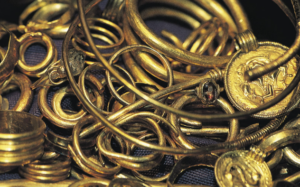
A local resident walking along a woodland path near the Rold region of Denmark noticed two unusual objects glinting in the soil. Curious, he bent down and brushed away the dirt, revealing two heavy gold bracelets lying on the surface. Remarkably, no metal detector was needed to find them.
Rather than keeping the treasure, the man reported the discovery to the North Jutland Museum, where the items were submitted for Denmark’s official treasure evaluation process.
Museum experts immediately realized the significance of the find. Archaeologists were dispatched to the location the same day and began surveying the surrounding area with metal detectors. Their search quickly uncovered a third gold bracelet near the original discovery site.
Just 15 meters away, another detector signal led researchers to an even more astonishing find. Buried beneath the soil were three additional gold bracelets, carefully stacked on top of one another.
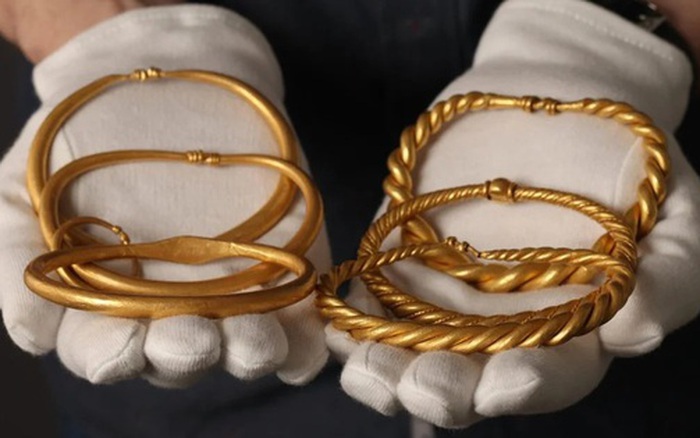
In total, six intact gold bracelets were recovered, weighing an impressive 762.5 grams of nearly pure gold. The hoard is now recognized as the third largest gold treasure ever discovered in Denmark. Only the famous Tissø bracelet find of 1977 and the Fæsted treasure discovered in 2016 surpass it in size and value.
Archaeologist Torben Sarauw described the discovery as exceptionally rare. During the Viking Age and early medieval period, gold was typically reserved for society’s most powerful individuals. Finds of this scale are uncommon, but the fact that two of the bracelets were visible on the ground and discovered without any specialized equipment makes the discovery even more extraordinary.
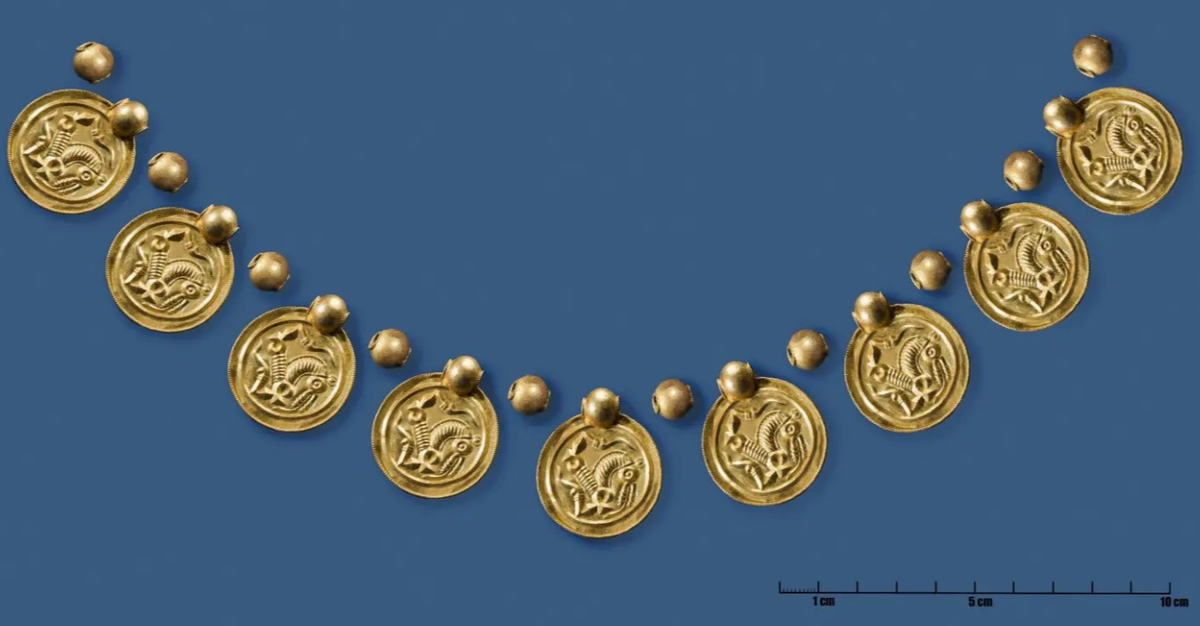
The bracelets display remarkable craftsmanship. Their surfaces feature alternating twisted gold strands and smooth geometric patterns, demonstrating the advanced metalworking skills of the artisans who created them more than a thousand years ago.
Experts have dated the treasure to between 900 and 1000 AD, a transformative period in Danish history when the kingdom was becoming increasingly unified. During this era, gold bracelets were powerful symbols of wealth, status, and political influence. Researchers believe the jewelry may have belonged to members of the Danish elite, possibly even individuals connected to the royal family.
Today, archaeologists continue to study the hoard in hopes of learning more about the people who owned it and the circumstances that led to its burial. Plans are underway to display the bracelets at the Aalborg History Museum, allowing the public to witness one of the most extraordinary gold discoveries ever made in Denmark.