The Monster That Ruled the Seas Before Sharks

Long before sharks became the rulers of the ocean…

Before dinosaurs ever walked the Earth…

A living tank dominated the ancient seas.

Its name was Dunkleosteus.
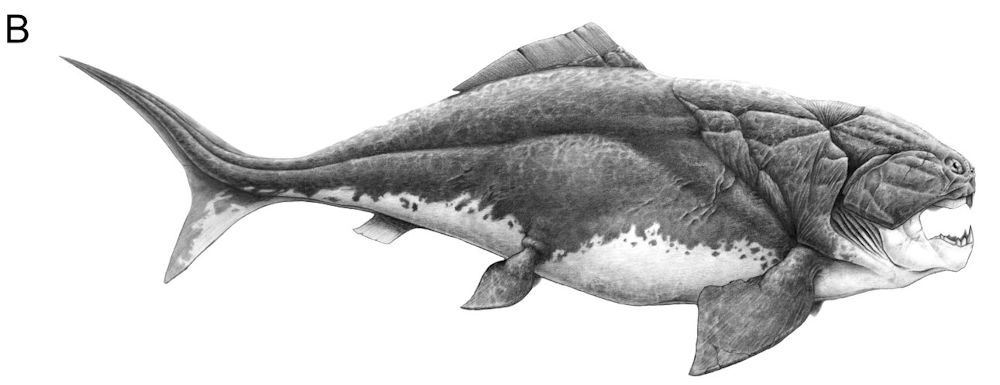
Palaeoartistic reconstruction of Dunkleosteus terrelli, the giant armored Devonian predator, figure 4B from Ferron, Martinez-Perez, and Botella 2017

Around 380 million years ago, this armored predator grew to the size of a bus, reaching lengths of over 30 feet and weighing several tons.

But its most terrifying weapon was not its size.

It was its bite.

Unlike modern predators, Dunkleosteus had no teeth.

Instead, its jaws were lined with massive self-sharpening bone blades that functioned like giant scissors.

When those jaws snapped shut, they generated an estimated 11,000 pounds of bite force—comparable to the legendary Tyrannosaurus rex.

At the tip of its bony fangs, pressure reached an astonishing 80,000 pounds per square inch.

Enough to crush armor.

Enough to slice through bone.

Enough to turn almost any creature in the Devonian Ocean into prey.

Scientists discovered something even more frightening.
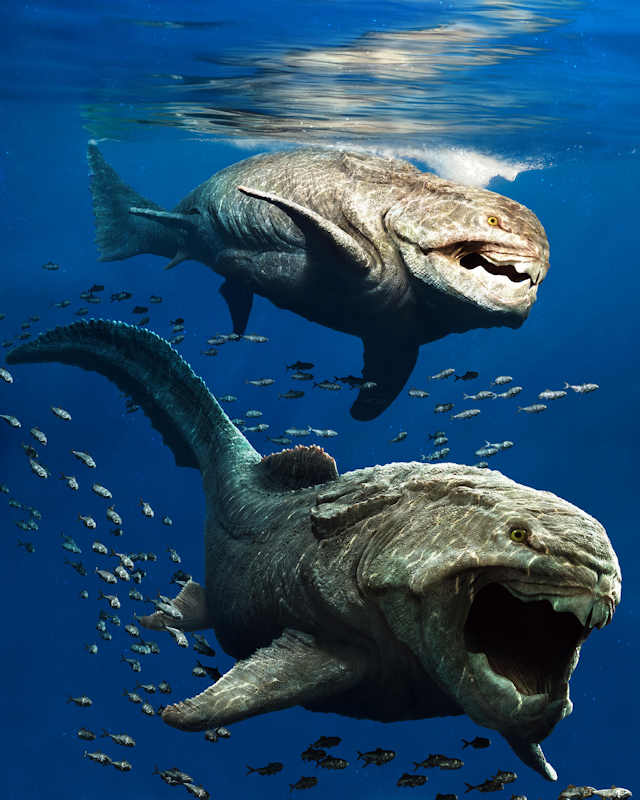
Artistic rendering of Dunkleosteus terrelli by Julian Johnson-Mortimer showing its armored head and jaw structure

Dunkleosteus could open its mouth with incredible speed, creating a powerful suction force that pulled victims directly toward its blades before they could escape.

It wasn’t just strong.

It was fast.

It was engineered to kill.

Researchers believe it could devour virtually anything in its environment, including heavily armored marine animals that other predators couldn’t touch.

Fossil evidence even suggests that it occasionally fed on members of its own species.

For millions of years, Dunkleosteus sat at the very top of the food chain.

One of the earliest apex predators ever known in the vertebrate fossil record.

A creature so efficient that some of its hunting adaptations appeared more than 100 million years before sharks evolved similar features.
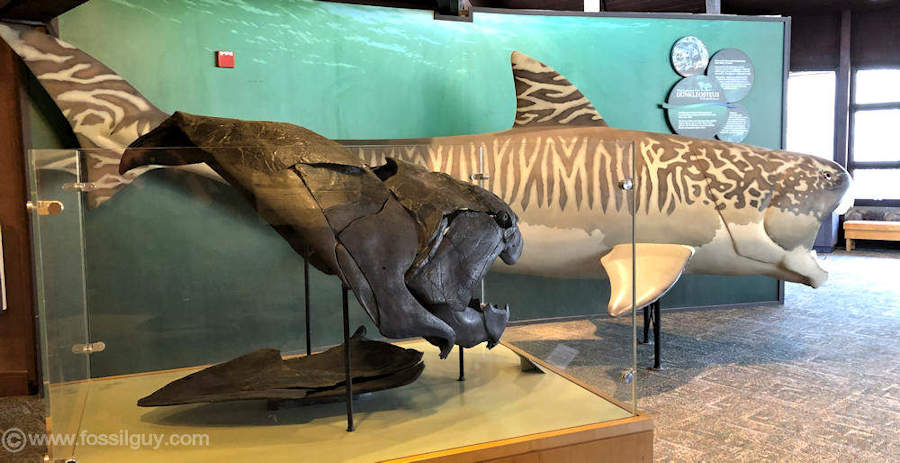
Life-sized Dunkleosteus terrelli model with fossil body armor cast on display at Rocky River Nature Center near Cleveland

The ocean has always created monsters.

Dunkleosteus was one of the first.

And even after hundreds of millions of years, it remains one of the most terrifying predators ever to emerge from the depths.

#Dunkleosteus #AncientOcean #PrehistoricPredator #Paleontology #Fossils #AncientCreatures #LostWorld

Related Posts

The Golden Tongues of Oxyrhynchus: Why Egypt Buried Its Dead With Mouths of Gold

The lamplight moved across the linen first — bandages wrapped in delicate geometric patterns, darkened by two thousand years underground. Then the archaeologists leaned closer to the…

More Than 1,200 Petroglyphs and a Rare Old Turkic Runic Inscription Found in Kazakhstan

“My Name Is Aba”: The 1,000-Year-Old Signature Hidden Among 1,200 Carvings in a Kazakh Gorge In a remote mountain gorge in southern Kazakhstan, the rock walls are…

🏺 The 1,000-Year-Old Feast Frozen in Stone: A King’s Decree, a Royal Banquet, and a Curse That Survived the Centuries

In a quiet farming village in East Java, beneath a mound of earth that locals had eyed suspiciously for forty years, archaeologists uncovered something that no historian…

Al-Naslaa: The Desert Rock Split So Perfectly That People Refuse to Believe Nature Did It

Somewhere in the northwestern deserts of Saudi Arabia, far from any city, two enormous slabs of sandstone stand alone against the horizon. From a distance they look…

 THE 4,000-YEAR-OLD ROCK THAT LOOKS LIKE IT WAS CUT BY A LASER

Deep in the Saudi Arabian desert stands one of the world’s most mysterious geological formations. Known as Al-Naslaa, this massive sandstone rock appears to have been sliced…

The Lighthouse of Alexandria Rises Again: 22 Giant Blocks Surface After 2,000 Years Beneath the Sea

For almost two thousand years, it lay in pieces on the floor of the Mediterranean — a shattered giant, swallowed by the same sea it once helped…

Leave a Reply

Your email address will not be published. Required fields are marked *