A Body Emerges From the Ice
On September 19, 1991, two hikers crossed a remote glacier high in the Ötztal Alps near the border between Italy and Austria.
What they saw protruding from the melting ice looked tragic—but not extraordinary.
A dead mountaineer.
Perhaps someone who had vanished during a recent expedition.
The body appeared weathered, partially exposed, and trapped in frozen snow.
Authorities prepared for a routine recovery.
They couldn’t have been more wrong.
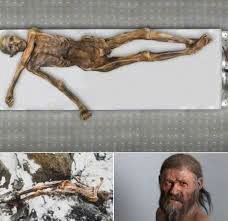
The corpse was not decades old.
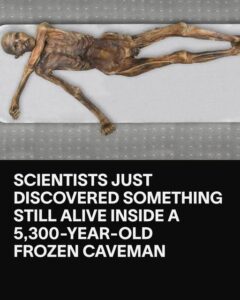
It was more than 5,300 years old.
And it belonged to a man whose death would become one of archaeology’s greatest mysteries.
The world would come to know him as Ötzi the Iceman.
But as scientists soon discovered, Ötzi was not simply a frozen traveler lost in the mountains.
He may have been the victim of a prehistoric murder.

The Man Frozen in Time
Radiocarbon dating revealed an astonishing truth.
Ötzi lived around 3300 BCE, during Europe’s Copper Age.
This was a time before the pyramids of Egypt were completed.
Before Stonehenge reached its final form.
Before recorded history existed across much of Europe.
Yet there he was.
Perfectly preserved.
The glacier had acted like a natural time capsule.
His skin remained intact.
His clothing survived.
Even the contents of his stomach were still present.
For archaeologists, it was like discovering a living photograph from the distant past.
Every inch of his body held clues.
Every object around him told a story.
And every discovery deepened the mystery.
What Was He Wearing?
Ötzi was dressed for survival.
Not in royal garments.
Not in ceremonial robes.
But in practical clothing crafted from nature.
His outfit consisted of stitched animal skins from goats, sheep, and deer.
He wore a grass cloak that functioned much like a modern raincoat.
His shoes were ingeniously designed with leather and insulating grass stuffing, making them surprisingly effective against alpine cold.
This was not a primitive caveman.
This was an experienced traveler who understood his environment.
Someone had invested considerable effort into making sure he survived the mountains.
Yet somehow, he never made it home.
The Most Valuable Weapon of His Age
Beside his body lay an object that stunned researchers.
A copper axe.
Today it may seem ordinary.
Five thousand years ago, it was extraordinary.
Copper technology was rare and valuable.
Owning such a weapon suggested status, wealth, or influence.
The axe was nearly pure copper, representing some of the most advanced metallurgy of the era.
Whoever Ötzi was, he was not insignificant.
He carried one of the most valuable tools of his world.
Which raises a troubling question.
If robbery was the motive behind his death…
Why was the axe still there?
The Last Meal
Scientists eventually analyzed Ötzi’s stomach contents.
What they found revealed the final hours of his life.
His last meal included meat from Alpine ibex and red deer.
He also consumed grains, likely einkorn wheat.
The food was rich in fat and calories.
Exactly what a traveler would need before crossing dangerous mountain terrain.
This wasn’t a starving man fleeing for survival.
He had eaten recently.
He appeared prepared.
He was moving with purpose.
Then something happened.
Something violent.
The Arrow Hidden Beneath His Skin
For years, researchers believed exposure killed him.
Then advanced scans revealed a shocking discovery.
An arrowhead was lodged deep in his left shoulder.
The projectile had severed a major artery.
The wound would have caused rapid blood loss.
In other words, Ötzi didn’t simply die in the mountains.
He was shot.
The revelation transformed the story completely.
This was no accident.
This was a homicide investigation delayed by more than five millennia.
The oldest cold case on Earth had suddenly become much colder.
A Violent Final Day
Further examination uncovered additional injuries.
Cuts on his hands.
Bruises on his body.
Signs of physical struggle.
Evidence suggested he may have been involved in combat shortly before death.
Some researchers believe he was fleeing attackers.
Others propose he had survived a battle and escaped into the mountains before being ambushed.
One thing became clear.
Ötzi’s final day was anything but peaceful.
He was wounded.
Pursued.
And ultimately struck down by an arrow from a distance.
Then left where he fell.
For over 5,000 years.
The Ancient Tattoos
Another mystery covered his body.
Ötzi possessed more than 60 tattoos.
Not decorative artwork.
Simple lines and crosses.
Many were located near joints and areas affected by wear and pain.
Researchers believe they may represent an early therapeutic practice—possibly a precursor to acupuncture.
If true, they could be among the oldest medical treatments ever documented.
The markings suggest that Copper Age people understood pain management far better than previously believed.
Even after death, Ötzi continued rewriting history.
What His DNA Revealed
The secrets hidden inside his body extended beyond visible evidence.
Scientists extracted ancient DNA from his remains.
The results revealed details nobody could have imagined.
They identified his ancestry.
His physical traits.
Even the bacteria living inside his digestive system.
One remarkable discovery was an ancient strain of Helicobacter pylori.
The microbe is associated with stomach ulcers and digestive problems today.
Which means Ötzi may have suffered chronic stomach discomfort thousands of years ago.
The glacier had preserved not only the man.
It had preserved an entire microscopic ecosystem from prehistory.
Why Was He in the Mountains?
This question remains unanswered.
Some theories suggest he was a trader crossing alpine routes.
Others believe he was fleeing enemies.
Some propose he was a leader involved in political conflict.
The evidence supports several possibilities.
Yet none explain everything.
Why was he alone?
Who shot him?
Why leave valuable possessions behind?
And perhaps most importantly…
Who wanted him dead?
The mountains remain silent.
The Cold Case That Refuses to End
More than three decades after his discovery, Ötzi continues to challenge scientists.
New technologies reveal new clues.
Each breakthrough answers one question while creating another.
His body has become one of the most studied archaeological discoveries in human history.
Yet the central mystery remains unresolved.
A man climbed into the Alps 5,300 years ago.
He carried valuable tools.
He ate a final meal.
He suffered injuries.
Then an arrow struck him.
He collapsed into the snow.
And the glacier sealed his story away from the world.
Until the ice finally gave him back.
The Secret Still Frozen Beneath the Surface
Most archaeological discoveries tell us how people lived.
Ötzi tells us how someone died.
That difference is what makes his story unforgettable.
He is not merely a mummy.
He is a witness.
A messenger from a forgotten world.
A murder victim whose killer vanished before the first written language appeared in Europe.
And despite thousands of scientific studies, countless scans, and decades of research, one haunting truth remains.
We know almost everything about Ötzi.
Except who killed him.
And perhaps that is why, after more than 5,300 years, the Iceman still refuses to reveal his final secret.