Hidden Above the Yangtze, an Ancient Mountain Guards a Secret Older Than Empires
For nearly two thousand years, travelers sailing through the mist-covered waters of the Yangtze River have looked toward a lonely mountain rising from the fog.
At first glance, it appears peaceful.
Ancient temples cling to its slopes.
Stone stairways disappear into the clouds.
Silent statues watch from the shadows.
But according to Chinese legend, this is no ordinary mountain.
This is Mingshan Mountain in Fengdu.
And many believe it is the closest place on Earth to the entrance of the underworld.
For centuries, emperors, pilgrims, monks, and ordinary villagers feared what waited beyond its gates.
Because local tradition claims that every soul must pass through this mountain after death.
And there, judgment awaits.
The Birth of China’s Most Terrifying Legend
The origins of Fengdu’s mystery stretch back to the Eastern Han Dynasty nearly 2,000 years ago.
Historical accounts tell of two imperial officials named Yin Changsheng and Wang Fangping.
Disillusioned with worldly life, they abandoned the imperial court and retreated to Mingshan Mountain to practice Taoism.
According to legend, both men achieved immortality.
But something strange happened.
Over time, their surnames—Yin and Wang—merged into the phrase “Yin Wang,” which sounds remarkably similar to the Chinese title for the King of Hell.
A legend was born.
Soon, people began to believe that Mingshan Mountain was not merely a sacred Taoist site.
It was the earthly headquarters of the ruler of the dead.
And Fengdu became known throughout China as the Ghost City.
A City Built for the Dead

Unlike most ancient religious sites, Fengdu was designed to terrify.
Its temples and monuments were not built to celebrate life.
They were built to remind visitors what awaited sinners after death.
Throughout the complex stand grotesque demons, stone judges, monstrous guardians, and scenes of eternal punishment.
Visitors walk through massive gates said to mark the boundary between the living world and the realm beyond.
Every step deeper into the mountain feels like entering another reality.
Ancient Chinese beliefs taught that the soul could not simply pass into the next life.
It first had to be judged.
And Fengdu became the physical representation of that cosmic trial.
The Three Trials of the Dead
According to ancient tradition, every soul arriving in the afterlife must face three tests.
The first is the infamous Bridge of Helplessness.
Only the righteous may cross safely.
The wicked are cast into the abyss below.
Beyond the bridge stands the Ghost-Torturing Pass.
Here, spirits are questioned and judged for every action committed during life.
The final challenge takes place at Tianzi Palace, where the soul must prove its virtue before the King of Hell himself.
Even today, visitors reenact these ancient tests.
Many laugh nervously.
Others leave strangely unsettled.
Because somewhere beneath the theatrical displays lies a question humanity has asked for thousands of years:
What happens after we die?
The Giant Face Watching the River

Long before modern tourism arrived, a colossal face stared across the Yangtze Valley.
Carved into the mountainside is an enormous representation of Yama—the King of Hell.
Its eyes seem to follow visitors.
Its expression remains unreadable.
In local folklore, this stone giant watches every soul that approaches the underworld.
The scale is astonishing.
Even from a distance, the face dominates the landscape like a forgotten god emerging from the mountain itself.
Many travelers first glimpse it through river fog.
The experience feels less like archaeology and more like stepping into a myth.
Did Ancient China Build a Gateway to the Afterlife?
Archaeologists do not claim Fengdu is literally an entrance to another world.
Yet the site’s existence reveals something equally fascinating.
For nearly two millennia, generations of Chinese builders transformed an entire mountain into a symbolic map of death, judgment, morality, and rebirth.
Confucian beliefs.
Taoist philosophy.
Buddhist concepts of hell.
All merged into a single landscape unlike anywhere else on Earth.
What survives today is more than a tourist attraction.
It is one of humanity’s most elaborate attempts to visualize the unseen world.
The Mystery That Refuses to Die
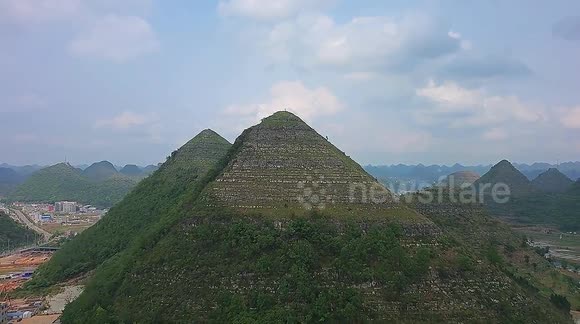
Many internet posts claim that hidden pyramids, forbidden tombs, and secret artifacts lie buried throughout China.
While extraordinary claims often lack evidence, China’s vast landscape does contain thousands of unexplored archaeological sites, imperial mausoleums, and ancient sacred mountains that continue to yield discoveries.
Yet perhaps the greatest mystery is not hidden underground.
It stands in plain sight.
A mountain covered in temples.
A city built for ghosts.
A place where generations believed the dead began their final journey.
And when the mist rolls across Mingshan Mountain at dusk, it becomes easy to understand why.
For a brief moment, the boundary between legend and history seems to disappear.
Leaving only one question behind:
Was Fengdu merely a monument to ancient beliefs…
Or was it built because someone thought the gates of the underworld were real?