Beneath the Soil of China, Entire Fortunes Waited in Silence
For centuries, they lay hidden beneath fields, villages, and forgotten landscapes.
No treasure maps marked their location.
No legends pointed the way.
No one knew they existed.
Then, in a series of astonishing discoveries, archaeologists and construction workers uncovered something extraordinary: vast stores of gold, mountains of ancient coins, and royal wealth buried so long ago that entire dynasties had risen and fallen above them.
These were not pirate treasures.
They were the forgotten fortunes of imperial China.
And they had been waiting underground for hundreds—sometimes thousands—of years.
![Gold coins, hoofs found in 2,000-year-old Chinese tomb[5]- Chinadaily.com.cn](https://www.chinadaily.com.cn/culture/attachement/jpg/site1/20151118/d8cb8a51564a17b6258857.jpg)
The Golden Secret Beneath a Han Dynasty Tomb
In Jiangxi Province, archaeologists investigating an ancient burial site made a discovery that immediately captured international attention.
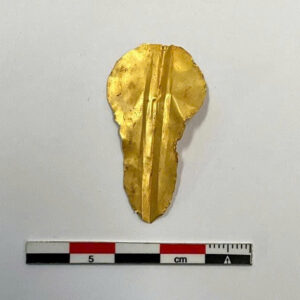
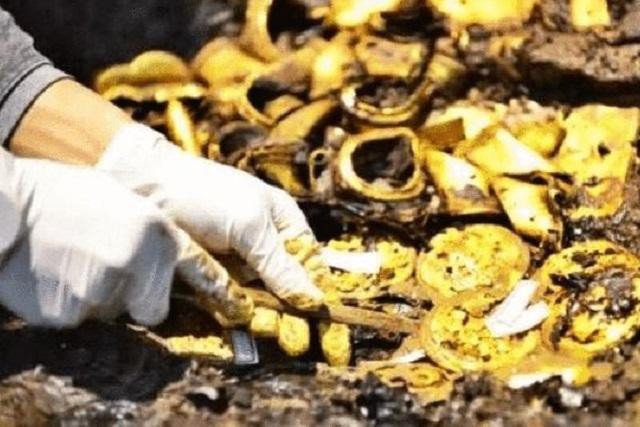
Hidden beneath the bed of a tomb dating back to the Han Dynasty, they uncovered more than 250 pounds (over 113 kilograms) of gold artifacts.
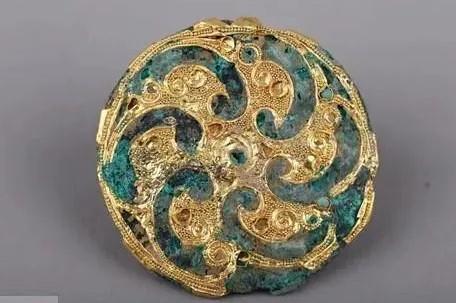
The treasure included gold plates, ingots, ornaments, and ceremonial objects.
For nearly two thousand years, the wealth had remained untouched.
The Han Dynasty ruled China from 206 BCE to 220 CE, an era often regarded as one of the greatest golden ages in Chinese history. It was a time of expanding trade, military power, technological innovation, and immense imperial wealth.
Yet even by Han standards, the quantity of gold discovered shocked researchers.
Who had owned such immense riches?
Why was so much wealth hidden beneath a tomb?
And how many more treasures remain buried beneath China’s vast landscape?
The answers remain elusive.
But this discovery was only the beginning.

A River of Coins Frozen in Time
Thousands of kilometers away, another remarkable discovery emerged from the earth.
In Shaanxi Province, workers stumbled upon an enormous cache of ancient coins.
As archaeologists began excavating the site, the scale of the find became increasingly difficult to comprehend.
The coins weighed more than three tons.
Some estimates suggested that hundreds of thousands of individual coins had been buried together.
Most dated to the Song Dynasty, one of China’s most prosperous and commercially advanced periods.
For nearly a thousand years, the treasure had remained hidden.
The Song Dynasty transformed China into one of the most sophisticated economies on Earth.
Paper money emerged.
Trade flourished.
Cities grew larger than many European capitals of the time.
The buried coins represented more than wealth.
They represented a snapshot of a civilization at its economic peak.
Yet one mystery remained.
Why would someone bury such a fortune and never return?

The Treasure That Outlived Empires
History offers many possibilities.
Throughout China’s long past, dynasties rose and collapsed with stunning regularity.
Wars swept across provinces.
Rebellions erupted without warning.
Invading armies crossed borders.
Entire cities vanished beneath violence and chaos.
When danger approached, wealthy families often buried their valuables in secret locations, hoping to retrieve them once peace returned.
Sometimes they never survived.
Sometimes they were forced to flee forever.
Sometimes their descendants forgot where the treasure had been hidden.
Over generations, the knowledge disappeared.
The earth became the only guardian of their wealth.
For centuries, the buried fortunes remained silent witnesses to forgotten tragedies.
The Lost Wealth of the Marquis of Haihun
China’s archaeological record contains even more astonishing examples.
One of the most spectacular discoveries occurred at the tomb of the Marquis of Haihun in Jiangxi Province.
The tomb belonged to Liu He, a Han Dynasty emperor who ruled for only 27 days before being removed from power.
Despite his brief reign, he was buried with unimaginable wealth.
Archaeologists uncovered more than 300 gold artifacts and nearly two million bronze coins.
The total weight of the coins approached ten tons.
It was one of the richest tomb discoveries ever made in China.
The burial offered a rare glimpse into the wealth, politics, and luxury of imperial life more than 2,000 years ago.
Yet perhaps the most remarkable aspect was not the treasure itself.
It was the realization that such wealth had remained hidden beneath the ground for centuries without anyone knowing it existed.

China’s Endless Underground Museum
Many people think of archaeology as the study of ruins.
China proves it is also the study of buried worlds.
Across the country, ancient roads, tombs, temples, palaces, and treasure hoards continue to emerge from beneath the soil.
Every major construction project carries the possibility of rewriting history.
A highway expansion may uncover a forgotten kingdom.
A village well may reveal a royal tomb.
A routine excavation may expose a treasure untouched since antiquity.
Unlike many ancient civilizations whose monuments stand above ground, much of China’s past remains concealed beneath layers of earth.
The result is a landscape that functions like a gigantic underground museum.
No one knows exactly what still lies hidden.

The Wealth That Time Could Not Destroy
Gold does not rust.
Coins can survive centuries underground.
But what truly survives is something even more valuable.
A story.
Every buried treasure represents a human moment frozen in time.
A merchant hiding his fortune from approaching soldiers.
A noble family protecting generations of accumulated wealth.
An emperor preparing for eternity.
The treasures discovered in Jiangxi and Shaanxi are not merely collections of precious metal.
They are messages from vanished worlds.
Each coin.
Each gold ingot.
Each artifact.
A whisper from people who never imagined their possessions would be seen again.
What Else Remains Hidden?
That question continues to haunt archaeologists.
China possesses one of the longest continuous civilizations in human history.
Thousands of years of dynasties, wars, migrations, and empires have left countless secrets beneath the ground.
Some may never be found.
Others may be discovered tomorrow.
A farmer plowing a field.
A construction crew digging foundations.
An archaeologist following a faint clue.
Any one of them could uncover the next great treasure.
Because somewhere beneath the soil of China, another forgotten fortune may still be waiting.
Silent.
Undisturbed.
Hidden in darkness.
Just as it has been for centuries.