Scientists have discovered the world’s largest ‘whale graveyard,’ used by this giant and intelligent ‘family’ for 5 million years.
According to Live Science, a massive whale graveyard has been discovered at the bottom of the Indian Ocean, stretching over 1,200 km and at depths of 4,200-7,000 m below sea level.
Named the “Diamantina Regional Cemetery,” this seabed area is where hundreds, possibly even thousands, of whales have found their final resting place.
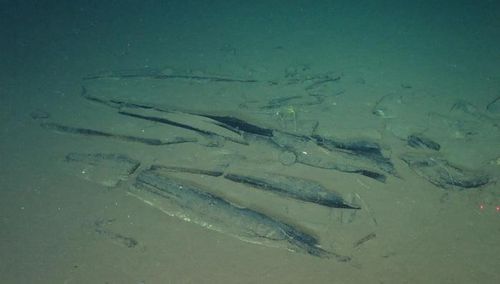
Giant whale graveyard at the bottom of the Indian Ocean – Photo: NATURE
In a study recently published in the journal Nature, Professor Xiaotong Peng from the Institute of Deep Sea Science and Technology (under the Chinese Academy of Sciences) and his colleagues used the Fendouzhe submarine to explore the seabed in the Diamantina region, an area with numerous underwater mountain ranges and fissures in the southeastern Indian Ocean.
Thirty-two expeditions helped identify a total of 476 whale fossils – some dating back up to 5 million years – and 5 recently deceased whale carcasses.
The largest carcass was the 5-meter-long skeleton of an Antarctic minke whale (Balaenoptera bonaerensis).
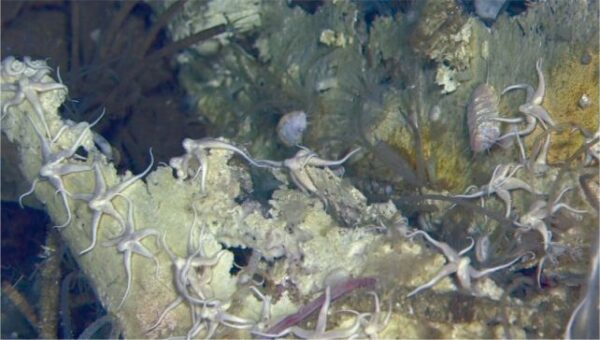
The five newly processed whale carcasses are covered in living bacteria that don’t need light or oxygen and break down the oil in the whale bones, producing hydrogen sulfide.
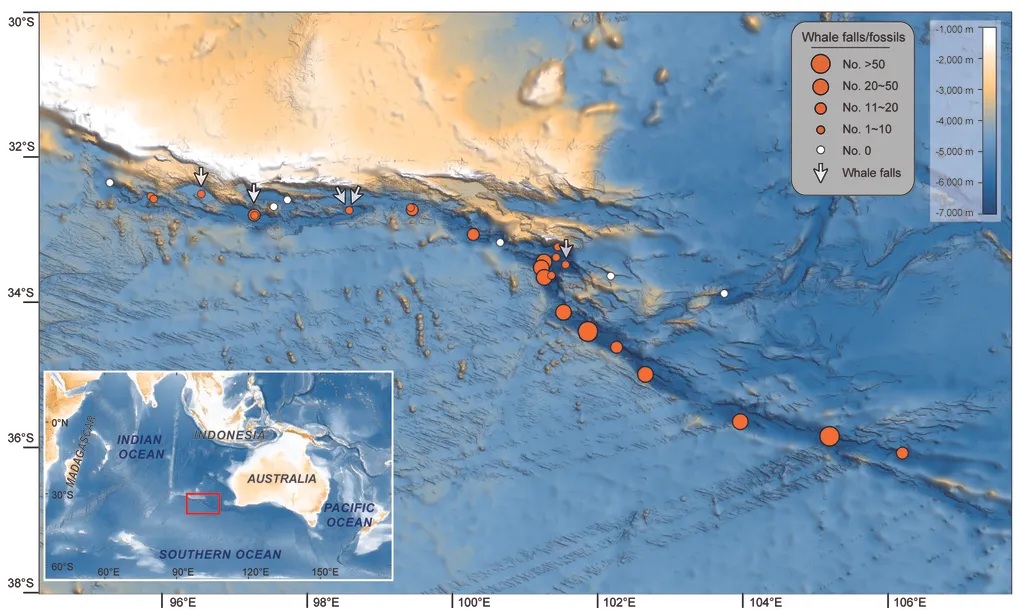
The location of the whale graveyard is marked on the map – Photo: NATURE
This chemical energy source allows the carcass to become a habitat for diverse populations of organisms such as jellyfish, starfish, bone-eating Osedax worms , and bivalve mollusks, with densities reaching up to 2,840 individuals per square meter.
Therefore, in addition to whale fossils, researchers also found countless fossils of other marine creatures in this mysterious “whale graveyard,” most of which are species enigmatic to science.
Professor Peng and his colleagues recovered 43 fossils and dated 33 of them based on the proportions of strontium isotopes present, indicating they included species of baleen whales, humpback whales, beaked whales, and more.
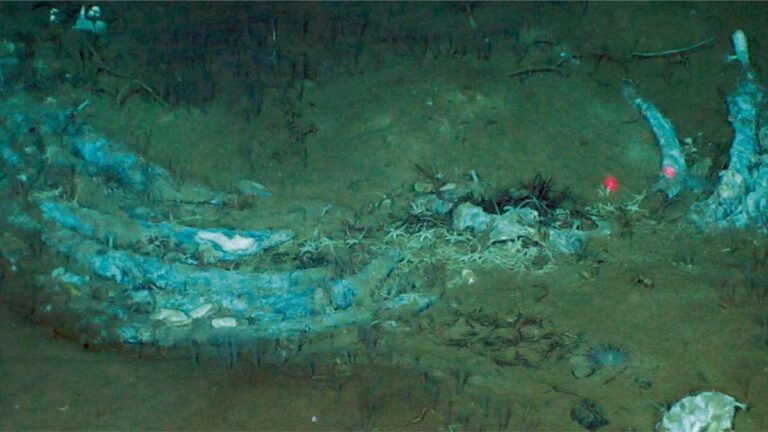
The oldest fossil belongs to an extinct species of beaked whale of the genus Pterocetus, dating back approximately 5.3 million years, to the early Pliocene epoch. Another fossil represents a new species, which the authors named Pterocetus diamantina.
The authors observed numerous squid and fish during dives in the Diamantina region, suggesting that this area is an ideal deep-water feeding ground for whales.
This explains why so many whales choose this place for their final resting place: They simply spent most of their lives in this area.
Furthermore, Professor Peng suggests that some beaked whales—the most common species in the graveyard—met with death while chasing prey at depths below their usual diving depth of 3,000 meters, resulting in lung collapse or decompression sickness. In other words, this area is not just a graveyard, but a death trap.